

Scan A QR.Ask The Product A Question.
Every physical product has a manual and most customers never read it. Product QR Guides turns the manual into a conversation: the customer scans a QR code, opens a hosted guide page, and asks the product anything. The AI answers from the manual and only from the manual.

The Actual Interface.
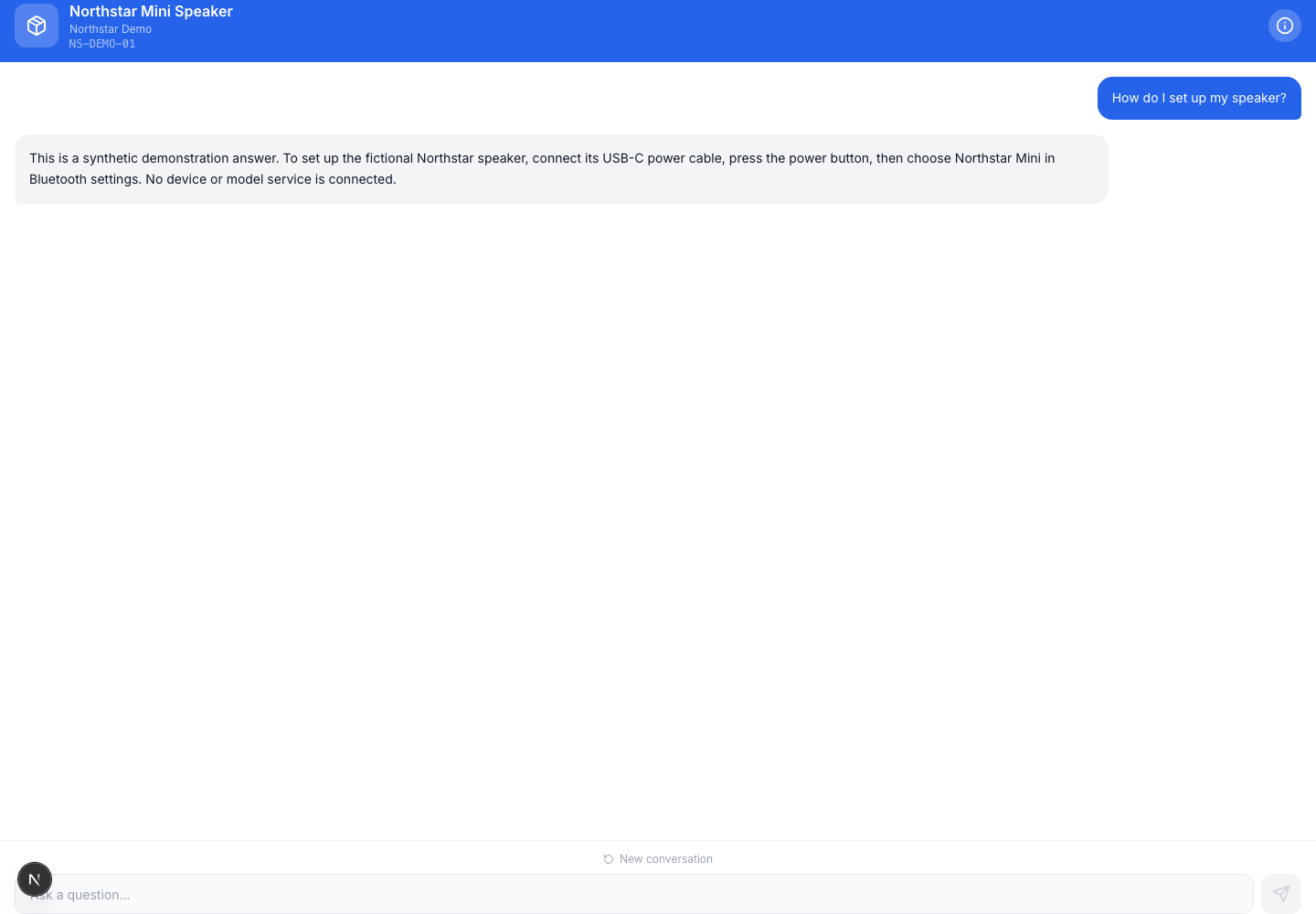
The Manual Is In The Box And Nobody Opens It.
The answer to almost every support call is already printed and shipped with the product. It is just in a format nobody reads, at the moment they need it, on the device they have in their hand.
A general-purpose chatbot is not a fix either: an assistant that improvises specifications is worse than no assistant at all.
One QR Code Per Sku, One AI Per Manual.
Physical to digital. Each physical product or SKU gets its own unique QR code linking to a hosted product guide page. The page displays key specs, navigable manual sections and the AI chat widget, all branded per client.
Grounded AI. The chat assistant runs on a language model and is strictly grounded via system prompt in the product's manual content only. The model is instructed to refuse any question outside the manual scope, so hallucination risk is eliminated by design rather than by luck.
Ingestion pipeline. PDF or text manuals are uploaded to Supabase, chunked and embedded for retrieval-augmented generation. At query time the most relevant chunks are retrieved and injected as context, so the AI answers from actual manual text rather than parametric memory.
Multi-tenant isolation. Each brand and SKU gets fully isolated manual content and isolated chat history. One deployment serves any number of clients and products: a refrigerator brand and a power tool brand share no data and no context.
Three Steps, And A Refusal Built Into The Last One.
Step 01, manual ingestion. The PDF or text manual is uploaded, parsed, chunked into semantically coherent sections and embedded using an embedding model. Vectors and source text are stored in Supabase with product and brand identifiers attached to every row.
Step 02, retrieval. The customer question is embedded and matched against that product's manual vectors using cosine similarity. Top-k chunks are retrieved from that product's isolated namespace only, with no cross-product context leakage.
Step 03, grounded generation. Retrieved chunks plus the customer question go to the model with a system prompt that explicitly instructs it to answer only from the provided manual excerpts and refuse any question outside scope. The AI cannot answer questions the manual does not cover.
- Language model
- Next.js
- Supabase
- Vercel
- pgvector
- PDF parser
Let’s Build What’s Next.
Bring the business problem. We’ll talk through what would make a difference and where to start.