

Hours Of Manual ExhibitReview, Gone.
An internal legal operations tool for a New York and New Jersey attorney handling SRO proceedings and complex litigation. One upload interface replaced reading, labelling, stamping and cross-referencing by hand; the attorney reviews the output instead of producing it.

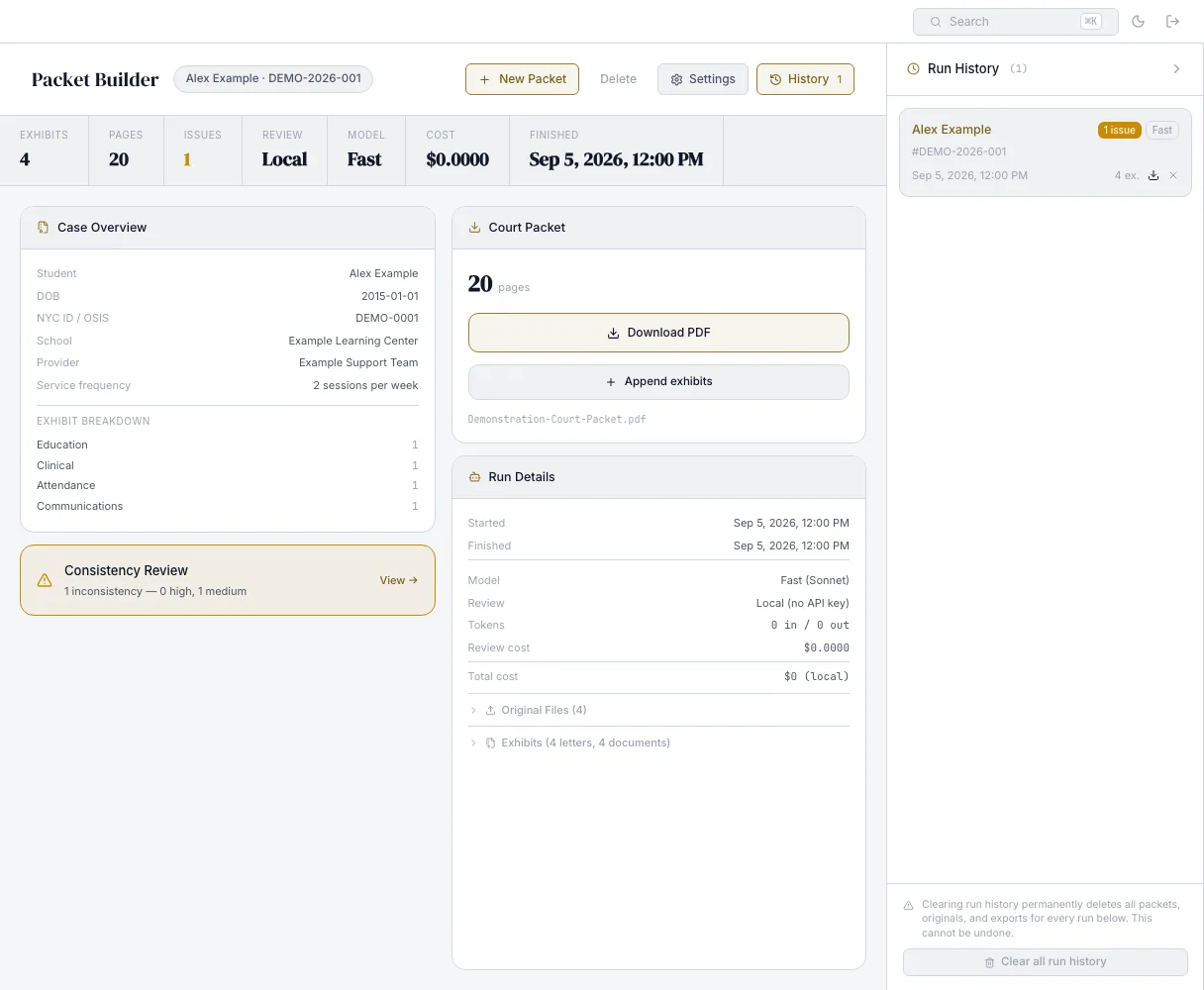
The Actual Interface.
The Billable Hour Was Going To Document Handling.
An exhibit package is produced by hand: read every document, decide what kind of exhibit it is, label it, apply sequential Bates numbers with the right case prefix, then go looking for analogous Special Review Officer decisions to cite. None of that is legal judgement. All of it is time a litigation attorney is paying for with their own week.
Manual numbering is also where errors enter a production. A skipped or duplicated Bates number is a problem discovered at exactly the wrong moment.
Upload Once, Get A Production-Ready Package.
Exhibit classification. Upload any PDF, image or scan. A reasoning model reads the document, classifies the exhibit type, financial record, communication, corporate filing and so on, and returns a label with a confidence score.
Matter extraction. A second model handles OCR on scanned and image-based documents, then pulls case references, party names, dates and dollar amounts into structured JSON, ready for downstream processing or export.
Bates stamping. A configurable prefix, the case number plus client code, is applied through pdf-lib. Stamped PDFs are generated and packaged into an organised bundle ready for production. No manual numbering, no numbering errors.
SRO research. The attorney enters the key facts of a matter; the model searches and summarises analogous Special Review Officer decisions and returns the relevant rulings with excerpts. Hours of case research in under a minute.
Two Models, Each Doing The Job It Is Actually Good At.
Classification and research. A reasoning model reads full documents to determine exhibit type and confidence score, and powers the SRO research module that surfaces analogous rulings from matter facts.
OCR and extraction. A second, document-specialised model handles OCR on scanned and image-based documents and extracts structured entities into JSON for downstream use.
Streaming file handling. Files stream through the pipeline rather than sitting in the database as full PDFs. Multer handles uploads, pdf-lib handles stamping, and the output is bundled for download on completion.
- React
- Express
- Reasoning model
- OCR model
- pdf-lib
- Multer
Let’s Build What’s Next.
Bring the business problem. We’ll talk through what would make a difference and where to start.