
AI-Native MVP Development: What Founders Actually Need
Build AI native MVP development the right way: pick the right scope, ship production-ready fast, and avoid fragile wrappers that waste runway.

What Is AI-Native MVP Development?
An AI-native MVP is the smallest working product that delivers real user value through AI — not a prototype, not a mockup, not a no-code demo, and not a UI bolted on top of a GPT call. It's a functional product with real authentication, real data storage, real integrations, and enough functionality to be worth paying for on day one.
That distinction matters because the floor and the ceiling have both moved. Founders can ship faster than ever, but according to Chrono Innovation citing CB Insights and Demand Sage, 42% of startups still fail because they built something the market didn't want. Speed without a real problem just means you burn runway faster. And users in 2026 don't grade on a curve — an MVP with broken flows, slow load times, or hallucinating outputs gets closed and never reopened.
An AI-native MVP is the smallest version of your product where AI is the engine of value, not a feature sticker.
Here's the readiness matrix this article runs on:
| Stage | What it is | When it's enough |
|---|---|---|
| Wrapper | A UI on top of a public LLM API | Almost never — no moat |
| Prototype | Clickable demo, no real backend | Pitch decks, internal alignment |
| Validation MVP | Concierge or no-code build with one workflow | Proving willingness to pay |
| Production MVP | Real auth, data, integrations, evaluation | First 100 paying users |
| Full product | Hardened, scaled, multi-workflow | Post-PMF growth |
If you can't point to which row you're in — and which row you actually need — you're building blind.
Which AI MVP Is Worth Building First?
Pick the workflow customers already pay humans to do badly. That's your AI MVP. The strongest validation pattern is taking a manual, expensive process customers already pay for today and automating the core of it with AI (Source: Rewired). If nobody is paying for the manual version, AI doesn't fix that — it just gets you to "no" faster.
Force yourself to commit to one of each, in writing:
- One user: the specific person whose day this changes
- One job: the single task you're replacing or compressing
- One workflow: the critical path, start to finish
- One outcome: the metric that proves it worked
Write it as: [User] can [do thing] so that [outcome]. That's it. If you can't fit it in one sentence, you haven't scoped an MVP — you've scoped a roadmap (Source: DEV Community).
The thinnest meaningful AI value slice is the smallest possible cut of that workflow that's still useful to the user (Source: SpeedMVPs). Everything else gets cut from v1: settings panels, admin dashboards, second user types, integrations you "might need," edge-case automations. Park them. Ship the core loop.
Your validation metric should be brutal and binary. Conversion to paid. Repeat usage in week two. Time saved per task measured against the manual baseline. If you can't define what "worked" looks like before launch, you're not validating — you're hoping. For more on this trap, see [Why Your MVP is Taking Too Long (And How to Fix It)](/why-mvp-taking-too-long-how-to-fix-it) and [Stop Buying AI Tools. Start Building AI Systems.](/stop-buying-ai-tools-start-building-ai-systems).
Which Are the Best AI-Powered MVP Builders for Startups in 2026 — and When Are They Not Enough?
Use AI builders to validate. Use senior engineering to ship. Builder tools work for prototypes and concierge MVPs; production AI MVPs that handle real users, real data, and real money need code you own and an engineer reviewing the architecture.
The best builder tools share a specific feature set: web and mobile support, real backend logic, owned database structures, user authentication, business logic handling, rapid prototyping, and the ability to export generated code (Source: Rocket.new). That last one — code export — is the difference between a tool you can graduate from and a platform you're trapped on.
| Tool | Best for | Watch out for |
|---|---|---|
| Lovable, Bolt.new, v0 | Fast web app prototypes from prompts | Backend depth, lock-in |
| Replit | Full-stack prototyping with hosting | Production hardening |
| Bubble | No-code web apps with logic | Performance at scale |
| FlutterFlow | Cross-platform mobile MVPs | Custom native logic |
| Glide, Adalo | Internal tools, simple mobile apps | Complex business logic |
| Rocket.new | AI-generated full-stack MVPs | Maintainability handoff |
| Figma, Figma AI, Uizard, Visily, Galileo AI | UI design and wireframing | These don't ship product |
| tldraw, Excalidraw | Architecture sketches | Diagrams, not deliverables |
| Midjourney | Brand visuals, marketing assets | Not product UI |
Builder tools fall short the moment you hit any of the following: real authentication for paying users, sensitive data, third-party integrations beyond their connector library, custom AI evaluation, multi-tenant architecture, regulated industries, or any workflow where uptime and performance matter. According to Galaxy Weblinks, a travel management company saved $400,000 in development costs using Replit's AI-powered suite — but that's a validation win, not a production guarantee.
AI MVP vs Full Product: What Should You Build First?
Build the validation MVP first — almost always. Most founders should prove the core workflow with real money before funding a full v1. The cost gap is too steep to skip the step.
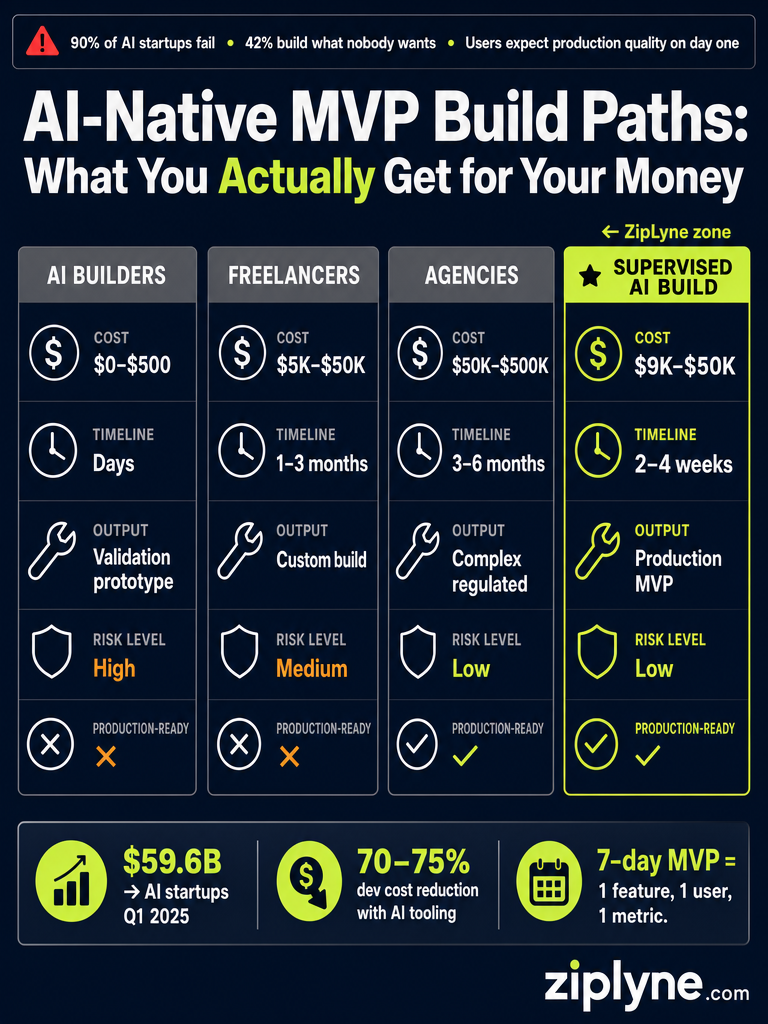
According to Chrono Innovation, founders in 2026 have four practical paths:
| Path | Cost | Timeline | Best for |
|---|---|---|---|
| AI builders | $0–$500 | Days | Validation prototypes, concierge MVPs |
| Freelancers | $5K–$50K | 1–3 months | Single-feature builds, light AI |
| Supervised AI build | $9K–$50K | 2–4 weeks | Production MVPs with real users |
| Traditional agency | $50K–$500K | 3–6 months | Complex, regulated, or enterprise scope |
Add the lighter-weight options for early validation: concierge MVP (you do the work manually behind a form), landing page MVP (sell it before you build it), clickable prototype (Figma + a story), and no-code MVP (Bubble or Glide for one workflow).
The math on the full product path is unforgiving. According to Chrono Innovation, professional software consultancies typically charge $100,000 to $200,000 for an MVP engagement, and expert-supervised AI builds cut that by 60–80% with the same production-grade output. SpeedMVPs frames the same gap differently: a usable production-quality AI MVP slice runs $15K–$40K in 2–4 weeks, while a fuller v1 launch runs $150K–$500K+ over 4–9 months.
The decision rule: if you haven't proven that someone will pay for the core workflow, building the full product is gambling. If you have proven it and you're hitting scale, validation builds will hold you back. Most founders are in row one and acting like they're in row two. For a deeper budget breakdown, see [The Real Cost of Building an MVP in 2026](/real-cost-building-mvp-2026-budget-breakdown).
How Do I Build an AI-Powered MVP Fast — Without Burning Runway?
Run a tight nine-step sequence and don't skip steps. Speed comes from cutting scope, not cutting rigor.
- Write the problem brief. One paragraph. Who, what, why now, what they pay for today, what success looks like. Use ChatGPT, Claude, or Gemini to pressure-test it.
- Define one user flow. Map the critical path end to end. According to the DEV Community guide, MVP wireframes should cover only the critical path and stay at 5–8 screens maximum.
- Audit data quality. AI is only as good as what you feed it. The LinkedIn corpus guide is direct: focus on quality data over quantity — clean and well-labeled beats large and messy.
- Choose the AI's role. Is it generating, classifying, retrieving, summarizing, or deciding? Be specific. "AI-powered" isn't a role.
- Design the critical path. According to 8tomic Labs, AI-assisted discovery and planning artifacts — PRD, technical spec, wireframe drafts — can be produced in under 48 hours using Claude, Gemini, Otter, Google Meet Transcription, and Notion AI.
- Build the core system. Use Cursor, Cursor IDE, Claude Code, GitHub Copilot, Gemini Code Assist, Tabnine, Codium, and DeepCode AI to compress the build. According to Galaxy Weblinks, AI coding assistants boost developer productivity by 15–55%, with GitHub Copilot used by nearly 42% of engineers.
- Test AI outputs and edge cases. Probabilistic systems fail probabilistically. Test for hallucinations, low-confidence outputs, bad retrieval, and weird inputs. TestGPT and similar tools help, but evaluation is your job, not the tool's.
- Launch to real users. Not your friends. Real users who will pay or refuse to pay.
- Iterate from metrics. Usage, retention, accuracy, time saved, willingness to pay. Cut what doesn't move them.
The discovery-to-deploy stack matters more than any single tool. According to 8tomic Labs, Cursor IDE, Claude Code, Supabase, and Vercel can produce a live MVP backend and frontend in 2–3 weeks. For a 30-day end-to-end framework, see [How to Build a SaaS Product with AI in 30 Days](/build-saas-product-ai-30-days).
Can You Build a Functional, Deployable MVP in 7 Days Using AI?
Yes — but only with one core feature, one user flow, and one validation metric. According to Novara Labs, that constraint set is what makes a 7-day AI MVP realistic; anything more and the timeline is marketing copy. Novara Labs also states that AI code generation accelerates development by 3–5x for experienced developers, which is what makes the 7-day window possible at all — but acceleration multiplies scope, it doesn't eliminate it.
Realistic timelines by scope:
| Scope | Timeline | Reality check |
|---|---|---|
| Single-feature concierge MVP | 7 days | One AI workflow, one user type, no payments |
| Production AI MVP, narrow scope | 1–4 weeks | Auth, data, deployment, basic evaluation |
| Production AI MVP, real integrations | 6–12 weeks | Multiple workflows, payments, hardened |
| Full v1 product | 4–9 months | Multi-feature, scaled, supported |
For corpus context: Groovy Web claims AI-first methodology produces 10–20X velocity versus teams that haven't adopted it, with well-scoped MVPs going live in 8–10 weeks. SpeedMVPs puts a usable production-quality AI MVP slice at 2–4 weeks. All true, all conditional on tight scope and senior execution.
The honest answer: 7 days gets you a validation slice. 2–4 weeks gets you a production MVP. Anyone promising a full product in either window is selling something.
What Stack Should a Production-Ready AI-Native MVP Use?
A production-ready AI-native MVP should use existing models and APIs rather than training custom models from scratch, with a stack built around Next.js or React Native on the frontend, Node.js or Python on the backend, PostgreSQL via Supabase for data, and OpenAI, Anthropic, or Gemini for the model layer. This is the default Rewired recommends for a fast AI MVP, and it's also where 8tomic Labs lands for their AI-native build pipeline.
| Layer | Default choice | Why |
|---|---|---|
| Frontend | Next.js | Fast, full-stack, Vercel-friendly |
| Mobile | React Native | One codebase, two platforms |
| Backend | Node.js or Python (FastAPI) | Mature AI ecosystem |
| Database | PostgreSQL via Supabase | Auth + DB + storage in one |
| Vector store | pgvector, Pinecone, or Weaviate | RAG for proprietary data |
| Cache | Redis | Token cost + latency control |
| Models | OpenAI GPT-4o, Anthropic Claude, Gemini | Production-grade, no training cost |
| Orchestration | LangChain or direct SDK calls | Depends on workflow complexity |
| Deployment | Vercel, AWS, or Azure | Vercel for speed, AWS for control |
| Analytics | PostHog, Mixpanel AI | Usage, funnels, retention |
| Models repo | Hugging Face | Specialized open-source where needed |
Train nothing in v1. The LinkedIn corpus guide is direct on this: leverage existing AI models and APIs from OpenAI, Hugging Face, AWS, and Azure rather than training a large model from scratch. Fine-tune only when prompts and retrieval can't get you there — and almost always, they can.
The cost trap nobody talks about loudly enough: AI API costs scale with usage, not seats. According to Rewired, API costs during an MVP run $50–$500/month, but that number explodes if you don't control token usage, cache aggressively, route models intelligently (cheap model for easy tasks, expensive model for hard ones), set rate limits, and design retries that don't loop. Build your unit economics around tokens before you have unit economics around dollars.
How Do You Avoid a Fragile GPT Wrapper?
Build defensibility into the workflow, not the prompt. Galaxy Weblinks calls out the thin-wrapper trap directly: putting a UI on top of a third-party API from OpenAI, Google, or Anthropic without a defensible moat means a single platform update can erase your business. According to Galaxy Weblinks, the projected AI startup failure rate is 90%, significantly higher than traditional tech — and thin wrappers are a major reason.
The moat checklist:
- Workflow ownership: you replaced a real process, not added a chat box
- Proprietary data: customer data, fine-tunes, retrieval indexes that no one else has
- Integrations: deep hooks into the systems your users already live in
- Distribution: a channel that doesn't depend on App Store featuring or SEO whims
- Operational lock-in: switching costs measured in weeks, not minutes
- Evaluation: you know when the AI is wrong before the user does
- Cost-aware architecture: your gross margin survives a 10x usage spike
Then handle AI failure like the production system it is. Hallucinations, low-confidence outputs, bad retrieval, and bad inputs aren't edge cases — they're the steady state of LLMs. Design fallback paths, confidence thresholds, and human-in-the-loop escalation before launch, not after a customer screenshots something embarrassing.
Production basics that aren't optional, even at MVP:
- Secure authentication (don't roll your own; use Supabase Auth, Auth0, or Clerk)
- Encryption at rest and in transit
- Privacy controls and data deletion paths
- Logging and monitoring on every AI call
- CI/CD with rollback
- Regular audits, especially if you touch sensitive data
The LinkedIn corpus guide is blunt: AI MVPs need security and privacy basics from the start, including encryption, secure authentication, and regular audits. Skipping any of these doesn't save you time — it just moves the cost to the breach. For more on building real systems instead of stitching tools, see [What Real AI Integration Looks Like — Not the LinkedIn Version](/real-ai-integration-not-linkedin-version).
AI MVP Development Agency vs Traditional Dev Shop
You don't need three ML engineers and a data scientist for an AI MVP — you need one senior builder who has shipped AI products before, according to Rewired. The decision matrix:
| Option | When to choose | Cost / Timeline |
|---|---|---|
| AI builder tool (Lovable, Bolt.new, v0) | Validation prototype, no real users yet | $0–$500, days |
| Freelancer | Single feature, light AI, you can manage tech | $5K–$50K, 1–3 months |
| Senior AI builder / boutique | Real users, real data, production MVP | $9K–$50K, 2–4 weeks |
| AI-native agency | Multi-workflow MVP, need a team | $10K–$50K, 1–4 weeks |
| Traditional dev shop | Regulated, complex, deep enterprise scope | $30K–$150K, 3–6 months |
| Full in-house team | Post-PMF, ongoing roadmap | $300K+/year |
According to Novara Labs, AI-native agencies build in 1–4 weeks for $10,000–$50,000, while traditional dev shops take 3–6 months and charge $30,000–$150,000 for the same scope. Rewired compares its fractional approach against hiring two engineers at $300K/year — a fair comparison for any founder thinking about full-time hires before product-market fit.
You need a senior builder, not a tool, the moment any of the following are true: you have paying users, you handle sensitive data, you take payments, you have real integrations, you need AI evaluation, you need to scale, or you need production uptime. You need a traditional shop or in-house team when you're in regulated industries (healthcare, finance, legal) where AI-native speed without controls becomes a liability, or when scope genuinely requires a team of specialists.
ZipLyne fits in the senior-builder row: a done-for-you builder/operator option for founders who want production AI systems shipped in weeks, not months. Backed by 150+ products launched, $50M+ in revenue generated, and 250M+ views across launches. No agency bloat, no junior handoffs, no "AI strategy" decks — just shipped systems.
What Should You Watch in the First 10 Real-User Tests?
Test with 5–10 real users before any wider release, and watch what they don't say. According to the DEV Community guide, this is the right size cohort before launching publicly — and the interesting data isn't in the survey. It's in the moments users hesitate, ignore an AI output, retry the same prompt three different ways, abandon a flow halfway, or message you asking for help with something the product was supposed to do automatically. That's your roadmap.
Build a metrics dashboard before launch, not after. According to First Round Capital, startups that instrument analytics early are 2.5x more likely to raise their next round. The metrics that matter for an AI MVP:
- Activation: did the user reach the AI value moment?
- Retention: did they come back in week two?
- Conversion: did they pay, or commit to paying?
- Accuracy: how often does the AI output need correction?
- Time saved: against the manual baseline, in minutes
- Cost saved: dollars displaced from their current process
- Support load: how many tickets per active user?
- Willingness to pay: at what price does conversion drop?
According to Startup Genome, 34% of startups fail due to lack of product-market fit. Real-user testing is the cheapest insurance against being in that bucket. Five users will tell you more than five months of building.
If the data says the AI MVP is solving a real problem, double down — harden the production stack, expand the workflow, control the unit economics. If the data says it isn't, kill it fast and use what you learned for the next swing. Either outcome is a win compared to spending another six months building something nobody wants.
Ready to skip the prototype theater and ship a production AI MVP that real users will pay for? Let's build something real — one senior operator, real engineering, shipped in weeks.
Frequently asked questions
How do I know if my AI MVP idea is actually worth building?
Find out if someone is already paying a human to do the job badly. If there's an existing manual process with a real price tag, you have a market. If nobody pays for the manual version today, AI doesn't create demand—it just speeds up your path to 'no.'
What's the difference between an AI wrapper and a real AI product?
A wrapper puts a UI on a third-party API and calls it a product—no proprietary data, no real workflow ownership, no switching costs. A real AI product replaces a specific workflow, integrates with systems users already live in, and gets harder to leave the longer someone uses it.
When should I stop using no-code AI builder tools and hire someone to build properly?
The moment you have paying users, handle sensitive data, take payments, or need real integrations, builder tools become a liability—not an asset. Production uptime, auth, and AI failure paths need engineering judgment that no drag-and-drop platform provides.
How do I control AI API costs before my MVP has any real revenue?
Design your unit economics around tokens before you have revenue: cache aggressively, route cheap models to simple tasks and expensive models only to hard ones, set rate limits, and avoid retry loops. API costs scale with usage, not seats, so a single uncontrolled workflow can blow your budget overnight.
What metrics actually tell me if my AI MVP is working?
The metrics that matter are activation rate (did users reach the AI value moment), week-two retention, conversion to paid, AI output accuracy, and time saved versus the manual baseline. Define what 'worked' looks like before you launch—if you can't, you're not validating, you're guessing.
Sources
- Non-technical founders: How are you actually building MVPs with AI?www.galaxyweblinks.com
- AI & MVP Development: Founders' 2026 Reality Checkwww.chronoinnovation.com
- MVP Development for Startups: The 2026 Guide - Chrono Innovationwww.linkedin.com
- AI MVP Development for Founders: Ship Your First Product Fasterwww.8tomiclabs.com