

Hebrew That KnowsWho Is Talking.
A context-aware Hebrew translator: not a dictionary lookup, but a system that understands register, gender and formality, shipped as a web app, iOS and Android apps, and a Chrome extension.

The Actual Interface.
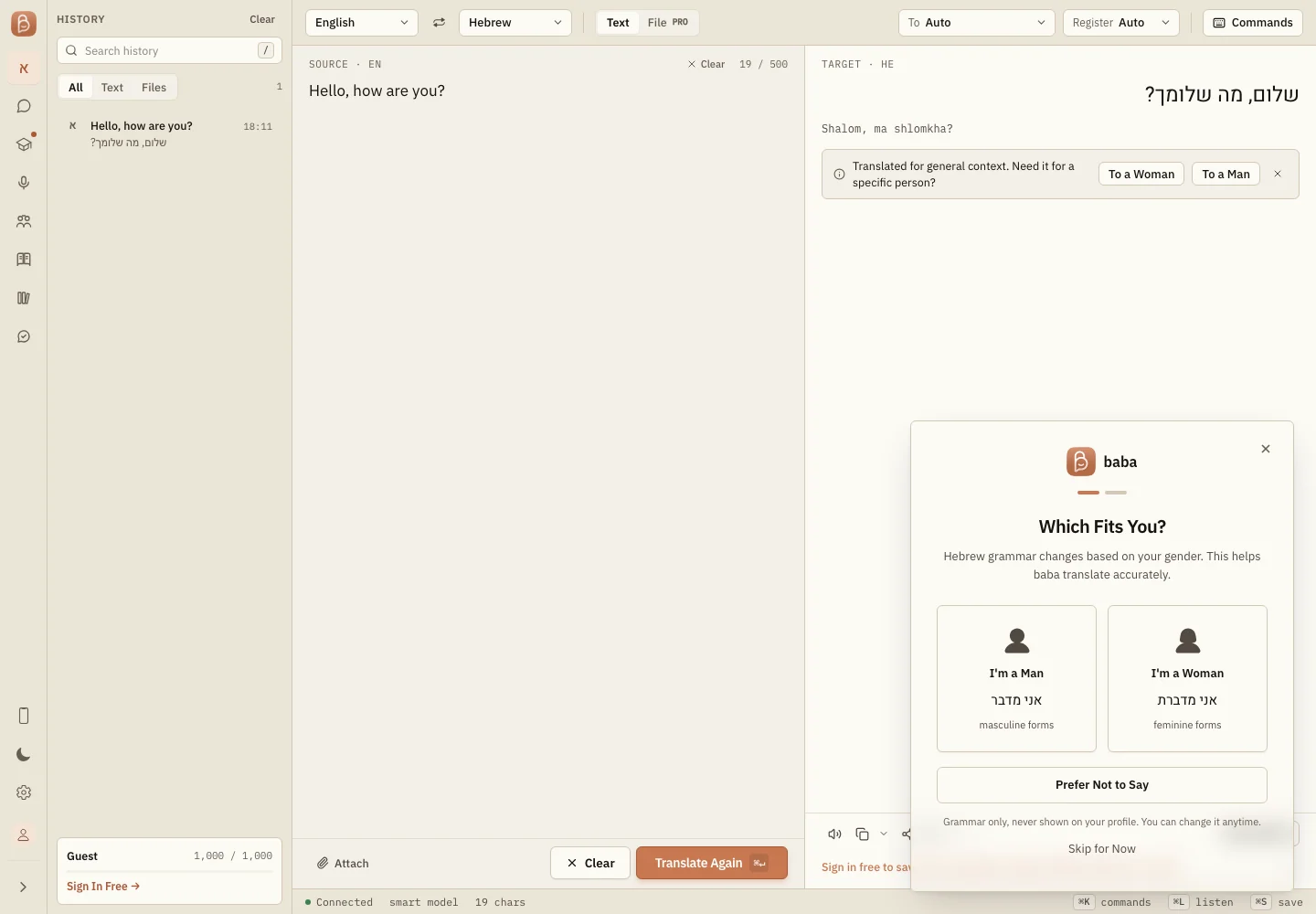
Hebrew Does Not Survive A Dictionary Lookup.
Hebrew encodes who is speaking and who is being spoken to. A verb changes on the gender of its subject; a sentence changes again on whether the exchange is formal or casual. A translator that ignores that returns technically correct output that a native speaker reads as wrong, which is most of what was already on the market.
Correcting for it after the fact does not work either. By the time a model has produced a sentence in the wrong register, patching the grammar means rewriting the sentence.
Eleven Prompts, Chosen Before The Model Ever Runs.
The grammar engine. Masculine and feminine crossed with formal and informal, eleven variants in all, each with its own tailored system prompt. Context detection routes a query to the correct variant before it reaches the model, so there is no post-hoc correction pass to get wrong.
Four platforms, one system. One Expo codebase spans iOS on the App Store and Android on Google Play. A separate React web app covers the desktop. A Chrome extension translates selected text in place, without leaving the page it is on.
The backend. A Cloudflare Worker handles routing, rate limiting and model selection; a routing layer supplies multi-model fallback, so when the primary model rate-limits, traffic fails over on its own. Zero cold starts.
Voice. Every translation surfaces a playback button. Text to speech streams native-quality Hebrew audio on demand, with no pre-recorded files, no static dictionary clips.
Four Steps From Typed Text To Spoken Hebrew.
- Context detection. Input is parsed for gender cues, register signals, and any explicit formal or informal preference.
- Variant selection. One of the eleven prompt templates is selected and injected along with the query.
- Routing to the model. Routed to the primary model with automatic fallback; returns Hebrew plus transliteration plus usage notes.
- Text to speech. The Hebrew output is piped for native pronunciation and streamed to the client on demand.
- Cloudflare Workers
- Multi-model routing
- Text to speech
- React
- Expo
- Chrome Extension APIs
Let’s Build What’s Next.
Bring the business problem. We’ll talk through what would make a difference and where to start.