
← Blog
Comparisons

AI Automation for Service Businesses With Too Much Admin

Start with the workflow leaking the most revenue: missed calls, slow follow-up, scheduling, invoicing, and email. Then build one production-ready lane at a time.

AI Automation for Service Businesses With Too Much Admin

AI automation for service businesses starts with missed calls and slow follow-up. Cut admin, speed invoicing, and save hours with one workflow.

  • AI automation
  • service businesses
  • admin work
  • missed calls
  • lead follow-up
  • invoicing
AI Automation for Service Businesses With Too Much Admin featured image

Where should a service business put AI automation first?

Start with the workflow leaking the most revenue, not the one that annoys you most. For most service businesses, that's missed calls and slow lead follow-up — money walking out the door before anyone touches a spreadsheet. Digital Fractal Technologies frames admin work as a drain that often eats 40–60% of a service business budget. That's not minor. That's where the cash hides.

Rank your admin leaks by two things: hours burned and dollars lost. Use this order as a starting triage:

Admin leakWhy it bleedsFirst-fix priority
Missed callsUnanswered calls don't call back (Digital Fractal)Highest
Slow lead follow-upFive-minute response wins; delay kills contactHighest
SchedulingEats hours; AI cuts it 60–80% (Digital Fractal)High
InvoicingDelays cash; automation speeds payment 30–50% (Digital Fractal)High
Email8 manual hrs/week → 2 (BizClearAI)Medium
Reporting & docs8 manual hrs/week → 3 (BizClearAI)Medium
Meeting notesPure overhead, no judgment neededLow-Medium

Rebel Fish Local frames AI for admin as a relief valve for overload, not a people replacement. Fix the leak that costs revenue before the one that costs patience. Then move down the list.

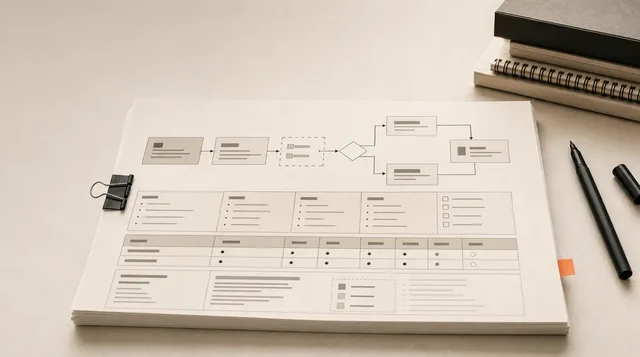
AI Automation for Service Businesses With Too Much Admin infographic

How to use AI to cut admin work in service businesses?

Map the workflow before you automate it. Digital Fractal Technologies makes the point plainly: adding automation to an unclear workflow amplifies the inefficiency instead of fixing it. You can't automate a mess — you can only make the mess move faster.

Build one lane at a time. Every reliable automation has the same skeleton:

  1. Trigger — what kicks it off (a missed call, a new lead, a sent invoice).
  2. Owner — who's responsible today, before AI takes the wheel.
  3. Action — the actual step being performed.
  4. Time and frequency — how long it takes and how often it runs.
  5. AI action — what the model sorts, drafts, extracts, or routes.
  6. System of record — where the result lands: CRM, calendar, inbox, bookkeeping tool.
  7. Exception path — what happens when the input is weird.
  8. Human escalation — who gets pinged when judgment is required.

Document the trigger, owner, action, time, and frequency in a simple table first. That's the audit. A workflow without an exception path and a human escalation isn't production-ready — it's a demo waiting to embarrass you. If you want help finding the leaks before you build, an AI operations audit ranks the fixes you can actually ship.

Watch

I Built a $5000 AI Automation for Plumbing Companies You Can Copy

From Hamza Automates on YouTube

What are the best AI admin automations for small businesses?

The ten highest-return AI admin automations are scheduling, email management, invoicing, expense tracking, reporting, document drafting, task management, customer support, file organization, and meeting note summaries — per BizClearAI's 2026 admin model. Most owners should start with one high-friction task: email follow-ups, invoice reminders, or calendar scheduling. BizClearAI models total admin time dropping from 32 hours per week to 9, saving 23 hours and roughly $1,350/month.

Here's the per-task breakdown from BizClearAI, with the tools commonly used to run each lane:

TaskManual → AI (hrs/wk)Saved/wkMonthly savingsCommon tools
Scheduling5 → 14 hrs$200Reclaim.ai, Clockwise, Microsoft Outlook
Email & communication8 → 26 hrs$300Microsoft Outlook
Invoicing & finances6 → 24 hrs$250
Reporting & docs8 → 35 hrs$300Microsoft Excel, Microsoft SharePoint
Customer support5 → 14 hrs$300
Meeting summariesOtter.ai, Fireflies.ai, Zoom, Google Meet

BizClearAI separately estimates AI scheduling tools save 3–5 hours/week and $200–$500/month, and AI email management with smart replies saves 5 hours/week and $300/month.

A full rundown of AI tools built to cut manual work and push more output goes deeper if you're shopping.

How does AI automate repetitive admin tasks in business?

AI handles admin by attacking structured, repetitive, pattern-based work — the stuff with consistent formats and a clear definition of "good." Rebel Fish Local notes this is the lowest-risk, highest-return place to start because mistakes are easy to catch. Gaotus lists the usual suspects: data entry, email sorting and responses, scheduling, and report generation.

The mechanics are the same every time. The model sorts incoming items, drafts replies or documents, extracts the data that matters, assigns ownership, captures deadlines, and updates the system of record. Rebel Fish Local breaks meeting work down the same way: transcription, action-item summaries, deadline extraction, ownership assignment, priority-aware scheduling, follow-up emails, and internal system updates.

The model is the engine, not the system. Tools like ChatGPT, Claude, and Gemini do the language work; orchestration layers like Microsoft Power Automate and Make.com connect the steps and move data between systems. AI doesn't replace your process — it runs the process you already defined, faster and without forgetting. Map the steps, then wire them.

Missed calls, slow follow-up, and delayed invoices: which admin leaks cost revenue?

Admin work isn't harmless busywork — it's where cash leaks out. Every unanswered call, slow reply, and late invoice is money you earned but didn't collect. Digital Fractal Technologies ties this directly to the numbers: 62% of calls to small businesses go unanswered, and 85% of those callers never call back.

Speed is the difference between a closed deal and a dead lead. Digital Fractal reports that responding to an inquiry within five minutes makes you 100 times more likely to make meaningful contact than waiting 30 minutes. Your follow-up speed is a revenue lever, not a courtesy.

The same logic runs through your invoicing. Digital Fractal states that automating invoicing speeds up payments by 30–50% — faster cash, healthier float, fewer awkward collection calls. And the cost comparison is brutal: AI scheduling tools start around $50/month against roughly $2,830/month for a receptionist.

The manual processes quietly draining your business usually hide in exactly these spots. Kill them first.

How do you calculate AI automation ROI before you buy or build?

Use one formula before you spend a dollar: hours spent per week × 52 × effective hourly rate. That's the annual cost of the manual work, and it's how Digital Fractal Technologies recommends prioritizing what to automate. For example, if a task burns 6 hours a week at a $50 effective rate, that's $15,600 a year leaking from one lane.

Run the math per workflow, then rank. The highest annual cost gets fixed first.

WorkflowHrs/wk× 52× $50/hrAnnual cost
Email & communication8416$20,800
Reporting & docs8416$20,800
Invoicing6312$15,600
Scheduling5260$13,000

Treat vendor and blog benchmarks as starting estimates, not guarantees. BizClearAI's per-task savings ranges and Digital Fractal's percentages are useful for sizing, but your real number comes from your own hours, frequency, and rate. The only ROI that matters is the one calculated from your business's actual time, not someone else's case study. Plug in your numbers, not the brochure's.

Are AI chatbots worth it for small businesses?

Chatbots and voicebots are worth it when the work is high-volume, repeatable, and currently going unanswered — intake, routine support, quote capture, booking, and first-line triage. They're not worth it for nuanced judgment calls or relationship-heavy conversations. The value ties straight to the missed-response problem: Digital Fractal Technologies reports AI can automate up to 82% of customer inquiries.

So the math is simple. If inquiries are slipping through the cracks, a bot that captures, answers, and books beats a phone ringing into voicemail. Tools like Zendesk get named in this space — confirm the specific capability fits your workflow before you commit.

The non-negotiable rule: build an escalation path. The bot handles the routine 82% and hands off the rest to a human the moment a question needs judgment. A chatbot without a clean human handoff doesn't save your customer experience — it quietly degrades it. Capture, answer, book, escalate. In that order.

Vertical platform vs connected tools vs custom AI automation: which should you choose?

Pick based on how messy and specific your workflows already are. A vertical platform is fastest to start but bends you to its design. Connecting your existing tools keeps your current stack but gets brittle as logic grows. A custom build fits your exact process but costs more upfront. There's no universal winner — only the right fit for your operation.

OptionBest forTrade-off
Vertical platformStandard service trades wanting one all-in-one systemLess flexible; you adapt to it
Connect existing tools (no-code)Lean stacks, simple workflowsCracks as complexity grows
Custom AI workflowSpecific, revenue-critical lanesHigher upfront effort

Vertical platforms are real and worth a look. Overhaulr positions its product for landscapers, painters, pressure washers, and tree services, bundling AI agents, CRM, bookkeeping, automation, website features, and mobile access in one platform. QuoteIQ's AI Autopilot runs quoting, invoicing, scheduling, marketing, reporting, customer texting, and job movement from typed or spoken commands.

Independent benchmark data comparing these vendors for small service businesses is limited as of this writing — so test against your own workflows, not a feature list. The deeper question of where no-code holds and where it breaks first against custom AI tools is worth settling before you sign anything.

How do you automate your business with AI with no coding required?

No-code AI automation handles simple, linear workflows with clean inputs — you wire triggers, AI actions, and system updates without writing a line of code. Rebel Fish Local's framing leans on this: structured, repetitive, format-consistent admin work is exactly what no-code tools handle well, because mistakes are easy to catch and you already know what good output looks like.

The cracks show up when workflows branch. Once you've got conditional logic, edge cases, data spread across five disconnected systems, and exceptions that need real judgment, a no-code chain starts dropping things silently. That's the brittleness threshold. The fix isn't more duct tape — it's a system built around your actual workflow.

No-code is the right call until your workflow has more exceptions than rules — then you're maintaining a fragile chain instead of running a system.

Three reads worth bookmarking before you go deeper:

What should you pilot first so AI does not break customer experience?

Pilot one workflow — the single highest-cost lane from your ROI math — and prove it before you touch anything else. Gaotus lays out the sequence: define objectives, integrate with existing systems, test in a pilot, and train the team before full deployment. Skip the pilot and you're rolling untested logic onto live customers.

Here's the production-ready pilot, in order:

  1. Set the objective — one measurable outcome (hours saved, response time cut, payments accelerated).
  2. Ship one workflow — trigger, AI action, system of record, exception path, human escalation. All five.
  3. Test before rollout — run it on real-but-contained inputs and watch where it stumbles.
  4. Train the team — they need to know what the AI does and when it hands off to them.
  5. Monitor output — check the results, not just the dashboard, for the first weeks.
  6. Keep humans on judgment — anything requiring nuance, strategy, or a relationship stays manual or gets escalated.

Digital Fractal's three buckets keep you honest: automate rule-based repeatable work, delegate work that needs judgment but not your expertise, keep strategic and relationship work human. Ship one reliable lane in production before you automate the second — proof beats ambition every time.

When you're ready to put one of these lanes into production instead of leaving it on a whiteboard, that's where ZipLyne builds. Let's build something real.

Frequently asked questions

How much admin time can AI actually save a small service business each week?

BizClearAI models total admin time dropping from 32 hours per week to 9 — a savings of 23 hours and roughly $1,350/month. Email alone drops from 8 hours to 2; scheduling from 5 to 1. These aren't theoretical ceilings — they're per-task estimates based on documented manual-to-AI hour comparisons across scheduling, invoicing, reporting, and customer support lanes.

What percentage of small business calls go unanswered, and what does that cost?

62% of calls to small businesses go unanswered, and 85% of those callers never call back — per Digital Fractal Technologies. That's not a customer service problem; it's a revenue leak. Responding to an inquiry within five minutes makes you 100 times more likely to make meaningful contact than waiting 30 minutes. Every missed call is a closed deal that never started.

How do you calculate ROI on AI automation before spending anything?

Multiply hours spent per week × 52 × your effective hourly rate. That's the annual cost of the manual work. An 8-hour-per-week email task at $50/hr costs $20,800 a year. Run that math per workflow, rank by annual cost, and automate the highest number first. Digital Fractal Technologies uses this formula to prioritize what to fix — your actual hours beat any vendor's case study.

What's the difference between a vertical platform and custom AI automation for a service business?

Vertical platforms like Overhaulr (built for landscapers, painters, and trades) or QuoteIQ bundle CRM, invoicing, scheduling, and automation in one system — fastest to start, but you adapt to their design. Custom AI automation fits your exact workflow but costs more upfront. If your process is standard, a vertical platform ships value this week. If your edge lives in a workflow no platform models, build the custom lane.

When does no-code AI automation break down for service businesses?

No-code handles simple, linear workflows with clean inputs well. The cracks show when workflows branch — conditional logic, edge cases, data spread across five disconnected systems, and exceptions requiring real judgment cause no-code chains to drop things silently. That's the brittleness threshold. The fix at that point isn't more duct tape; it's a system built around your actual workflow, not a tool chain held together by hope.

Are AI chatbots worth it for small service businesses?

Yes — when the work is high-volume, repeatable, and currently going unanswered. Digital Fractal Technologies reports AI can automate up to 82% of customer inquiries. The non-negotiable is building a clean human escalation path for the remaining 18%. A chatbot that captures, answers, and books beats a phone ringing into voicemail — but one without a handoff quietly degrades the customer experience instead of protecting it.

Sources