

How to validate a mobile app idea before building
Validate a mobile app idea by proving three things before you write code: the problem is real and urgent, users actually behave the way you assume, and someone will commit—not just compliment. The cheapest way to test all three is to simulate the outcome and see if anyone cares. According to RapidNative, 42% of failed startups cite lack of market need as the cause of death—more than running out of cash (29%) or the wrong team (23%).
That number should reorder your priorities. Slow engineering rarely kills a startup. Building something nobody needed does.
Mobile app MVP validation is the process of proving a real user has a real problem and will take real action before you build the app. Logicnord defines it as testing whether a product idea solves a real problem for real users before building the full product. RapidNative frames the same thing as swapping dangerous assumptions for hard evidence—turning a vague concept into something testable in hours, not months.
The tools that do this work are boring and fast: customer interviews, a landing-page smoke test, a clickable prototype, and a concierge MVP where you deliver the outcome by hand. Logicnord says most successful validation processes include 10–30 conversations with potential users before development starts.
Below, we break down the evidence ladder and the exact go/no-go thresholds that separate polite interest from real commitment.
Validate or build an MVP first?
Validate first—almost always. Build an MVP only when the risk left standing is about the interface or the workflow, not whether the problem exists or whether anyone will pay. If you're still guessing whether users care, a build doesn't answer that question. It just costs more to find out.
Sort your unknowns into three buckets:
- Problem risk – do users actually have this problem, and is it urgent? RapidNative says to confirm the problem is urgent and unsolved through interviews and surveys before building.
- Solution risk – does your proposed fix resonate? Run smoke tests or a concierge MVP.
- Willingness-to-pay risk – will they hand over money? Ask for pre-orders, deposits, or set up a "Buy Now" button.
If problem and willingness-to-pay risk are still wide open, don't build. RapidNative's own framework replaces "I know people want this—build the full app" with "talk to 20–30 potential users before building anything."
The order is fixed: prove the problem, then the solution, then the money—each before you commit engineering hours.
Only when the remaining question is "does this specific mobile workflow feel intuitive?" does a lean build earn its place. That's interface risk, and pixels answer it better than words do.
Is building an MVP enough to validate a startup idea?
No—a shipped MVP built from assumptions is not validation. It's an expensive assumption with a login screen. If you built it because you and your co-founder loved the idea, seeing it live proves you can build, not that anyone wants it. Build MVP Fast is blunt: don't build when the only evidence is "my co-founder and I love it" or one enthusiastic investor meeting.
The trap is that building feels productive. You see pixels on a phone, so it feels like progress. But a well-built product solving a problem nobody cares about is still dead. Logicnord notes that many failed projects were technically well built—the real issue was the product solved a problem users didn't care enough about.
An MVP validates a startup idea only when it was built on evidence from strangers, tied to real commitment, and shipped with a plan to reach users. Without those three, you've skipped validation and gone straight to expensive guessing.
Validation isn't one test—it's a stack of small bets, and building the app is the last one, not the first.
The distinction matters most for mobile. App-store work, review cycles, and platform assets add friction you can't undo cheaply. If you're going to burn that runway, burn it on a thing you already know people will use. For a deeper look at scoping this right, see what founders actually need in an AI-native MVP.
What evidence is strong enough to call an app idea validated?
Evidence strength climbs with commitment. Compliments cost nothing, so they prove nothing. Money, deposits, and repeated behavior cost something—which is exactly why they matter. Logicnord puts it plainly: the strongest validation signals usually involve some form of commitment rather than interest alone.
Rank your signals from weakest to strongest before you decide anything:
| Signal | What it proves | Strength |
|---|---|---|
| Compliments / "great idea" | Politeness | Weakest |
| Survey interest | Stated preference | Weak |
| Email / waitlist signup | Mild intent | Moderate |
| Demo or feature request | Active pull | Moderate |
| Switching intent ("I'd drop my current tool") | Behavioral signal | Strong |
| Pre-order or deposit | Money on the line | Strong |
| Repeated usage (concierge) | Real behavior | Strongest |
Build MVP Fast turns these into concrete bars: 50 email signups from cold traffic in two weeks, 5 paid pre-orders at $20, or 8 of 10 interviewees saying they'd switch from their current solution. RapidNative reinforces the top of the ladder—ask for pre-orders, deposits, or a working "Buy Now" button to test willingness-to-pay directly.
Two things to watch. First, evidence from friends and your co-founder sits at the bottom of the ladder regardless of enthusiasm. Build MVP Fast wants repeated evidence from strangers. Second, higher rungs override lower ones. Ten compliments don't outweigh zero pre-orders.
How many customer interviews do you need before building anything?
Plan for 10 to 30 interviews before you build. Logicnord says most successful validation processes include 10–30 conversations with potential users. RapidNative narrows it to 20–30 potential users before building anything to cut market risk. The point of the range isn't a magic number—it's enough conversations to see a pattern instead of one loud opinion.
Don't pitch during interviews. Logicnord is clear that interviews reveal how users currently solve the problem, how often it occurs, and how frustrating it is—not whether they like your slides.
Focus every conversation on four things:
- Current workaround – what do they use today to solve this?
- Frequency – how often does the problem hit them?
- Frustration – how painful is the current fix, in their words, not yours?
- Switching intent – would they actually drop their current solution?
If users already have a simple fix that works, Logicnord warns that convincing them to switch may be hard. That's a real finding, and it's cheaper to hear it now than after launch.
If most interviewees describe a workaround they're happy with, the problem isn't urgent enough to build against—stop and pick a sharper problem.
What should a landing page smoke test measure?
A smoke test measures behavior against a threshold you set beforehand—not warm reactions. Build MVP Fast is direct: define what success looks like before you run experiments, because vague goals like "people seemed interested" are confirmation bias, not validation. Set the bar first, then let cold traffic tell you the truth.
Here's the setup. One page: a headline stating the outcome, three bullets, and an email capture or "Join waitlist." Then Build MVP Fast recommends $200–500 in targeted ads to your exact audience—Meta, TikTok, or LinkedIn depending on whether you're B2C or B2B. Measure two numbers: click-through and signup rate.
The go/no-go bar from Build MVP Fast is concrete: 50 email signups from cold traffic in two weeks is a passing example. And the warning line matters most—below 2% signup from qualified clicks usually means messaging or problem fit is off, and you should fix that before building.
| Element | What to set | Source benchmark |
|---|---|---|
| Success bar | Signups in a fixed window | 50 signups in 2 weeks |
| Ad budget | Targeted spend | $200–500 |
| Channel | Match to audience | Meta / TikTok / LinkedIn |
| Warning threshold | Qualified-click signup rate | Below 2% = fix first |
Qualified clicks matter more than raw traffic. People who clicked because the message hit them are the real test. If they still don't sign up, the problem is your positioning or the problem itself—not your ad budget.
When is a concierge MVP better than a clickable prototype?
Choose a concierge MVP when the risk is in the workflow; choose a clickable prototype when the risk is in the interface. A concierge MVP delivers the outcome manually—no app, no code. Build MVP Fast frames the logic simply: if users won't engage when you're doing the work by hand, they won't engage when it's automated.
Concierge tests are for founders who don't yet know whether the end-to-end process works or whether people will use it at all. Build MVP Fast's examples are low-tech on purpose: a food delivery idea takes orders in a Google Form and you fulfill them yourself; a marketplace introduces buyers and sellers in a WhatsApp group. The payoff is that concierge teaches you the workflow bugs no prototype reveals.
Clickable prototypes and wireframes solve a different problem. Logicnord says founders can use interactive mockups or clickable wireframes to test whether the workflow feels intuitive and which features users consider most important. That's interface and priority risk—useful once you already know the underlying job matters.
| Question you're stuck on | Use this |
|---|---|
| Will anyone actually use this process? | Concierge MVP |
| Do the workflow steps hold up in real use? | Concierge MVP |
| Does the screen flow feel intuitive? | Clickable prototype |
| Which features matter most? | Clickable prototype |
A concierge MVP proves demand and process; a prototype proves the interface—don't use one to answer the other's question.
How do you validate an MVP before you build anything?
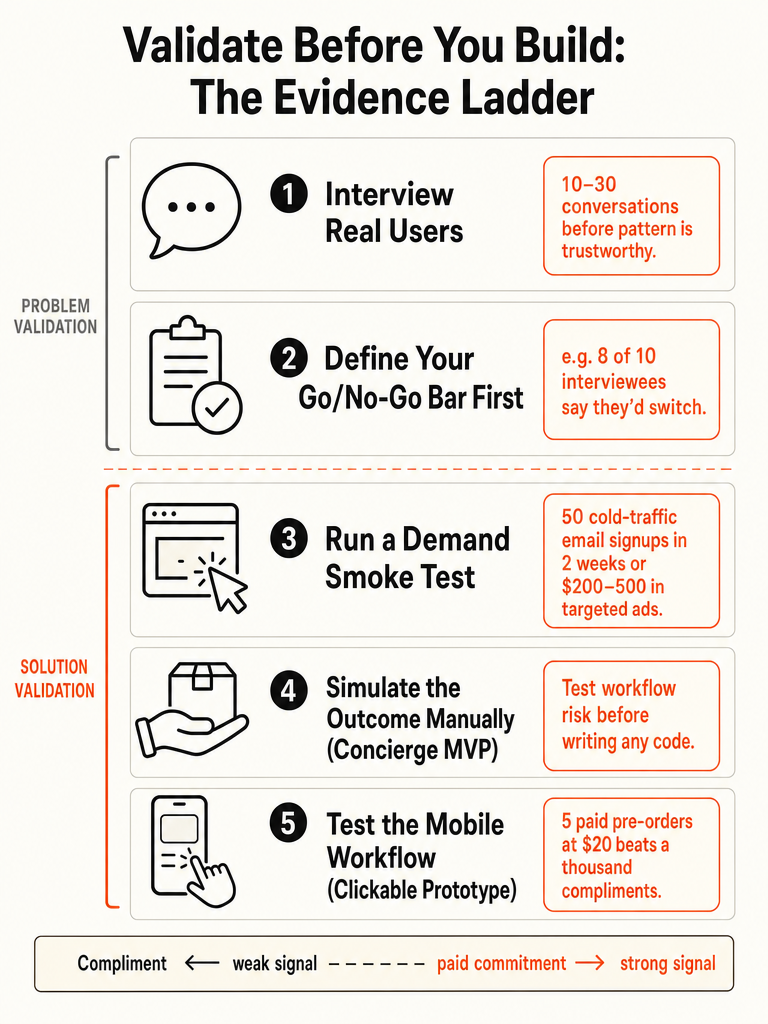
Run validation as a sequence, cheapest test first, with a threshold set before each step. Build MVP Fast's core rule anchors the whole thing: define the go/no-go decision up front, or you'll rationalize any result. The sequence stacks small bets so a weak signal kills the idea before it costs you a build.
- Define the success threshold. Pick your numbers now—50 signups in two weeks, 5 pre-orders at $20, or 8 of 10 interviewees willing to switch (all Build MVP Fast benchmarks).
- Interview users. Run 10–30 conversations (Logicnord) focused on current workaround, frequency, frustration, and switching intent.
- Test demand with a landing page. Spend $200–500 on targeted ads and watch for the below-2% qualified-click warning.
- Simulate the outcome manually. Build a concierge MVP with a Google Form or WhatsApp group and see if people actually engage.
- Test the mobile workflow. Only now use a clickable prototype to check whether the core user journey feels intuitive before any app-store work.
Each step answers a different risk—problem, demand, workflow, then interface. Skip a step and you carry that risk into the build.
Public detail on mobile app-store approval and beta-distribution constraints is limited in the sources here, so treat step five as workflow validation, not release readiness.
MVP vs full product: should you build lean or build big?
Build lean—and only after validation shows real commitment. Build MVP Fast sets the trigger: build when you have repeated evidence from strangers, a clear wedge feature, and a distribution hypothesis. A full, feature-packed product before that is a bet against your own data.
RapidNative calls the feature-packed V1 the flawed approach—building a heavy first version hoping it's what users want, instead of running smoke tests or a concierge MVP to confirm the solution resonates.
| Situation | Build scope |
|---|---|
| Demand still assumed, no stranger evidence | Don't build—keep validating |
| Repeated stranger signals + wedge feature + distribution plan | Build lean |
| "We'll add every feature to be safe" | Cut scope—that's runway you can't get back |
Lean means one thing: the smallest build that proves your next unknown. If your MVP is dragging, scope creep is usually why—here's how to fix an MVP that's taking too long.
What should founders build first: prototype, concierge MVP, or mobile app MVP?
Build the smallest artifact that exposes your next real unknown—not the most impressive one. If you don't know whether people will use the process, build a concierge MVP. If you don't know whether the screens make sense, build a clickable prototype. If demand and workflow are already proven and only the shipped experience is left, build the mobile app MVP.
The mistake is jumping straight to the app because it feels like the "real" work. Build MVP Fast's whole argument is that building is the most expensive test, so it should answer the last question, not the first.
Match the artifact to the risk:
- Prototype – interface and feature-priority risk. Fastest, cheapest, no engineering.
- Concierge MVP – demand and workflow risk. Manual delivery, real users, real behavior.
- Mobile app MVP – execution risk on a proven idea. Reserve it for last.
For a deeper split on when each one earns its place, see AI prototype vs MVP: what founders should build first.
The right first build is whichever one kills your biggest unknown for the least money—usually not the app.
How do you tell weak demand from bad messaging?
Read the pattern of signals, not a single failed test. Build MVP Fast gives one clean diagnostic: high click intent plus low email signup often means a pricing or trust issue, not an idea issue. The failure mode isn't always the problem—sometimes it's how you framed it, priced it, or whether people believed you.
Use the results to separate the causes:
- Weak problem – interviews reveal a workaround users are already happy with (Logicnord's warning). The problem isn't urgent. This is fatal; pick a sharper one.
- Bad messaging – below 2% signup from qualified clicks. Build MVP Fast ties this threshold to messaging or problem fit being off. Rewrite the headline and bullets before you touch the product.
- Pricing or trust issue – people click "Book now" or "Subscribe for $9/mo" but won't leave an email. Build MVP Fast reads high intent, low signup as pricing or trust—not a dead idea.
- Solution misfit – strong problem signals in interviews, but nobody engages with your concierge version. The problem is real; your fix isn't.
Don't guess which cause you're facing—each one shows a different pattern in the numbers you already collected, so let the data assign the blame.
Stick to signals your tests actually produced. The sources here don't cover broad industry conversion averages, so don't invent a benchmark to explain a soft result.
When do you stop validating and start building the mobile app MVP?
Stop validating and build when four things are true at once: repeated evidence from strangers, a clear wedge feature, measurable commitment, and a distribution hypothesis. Build MVP Fast names the first three directly and warns against building on "my co-founder and I love it" or one enthusiastic investor meeting. Commitment means money or behavior—pre-orders, deposits, repeated concierge usage—not applause.
Run this checklist before you write code:
- Repeated stranger evidence – multiple people you don't know showed the same signal, not one lucky conversation.
- A clear wedge feature – the single thing that pulls users in, sharp enough to lead with.
- Measurable commitment – 5 pre-orders at $20, switching intent from 8 of 10 interviewees, or real concierge engagement (Build MVP Fast benchmarks).
- A distribution hypothesis – a specific answer to how these users will find you.
Miss any one and you're still guessing. RapidNative's framing is the reason to hold the line: 42% of failed startups die from lack of market need, so the whole point of this gate is to make sure you're building something necessary, not just something you can build.
When all four clear, stop testing and ship. Speed after validation is an advantage; speed before it just gets you to failure faster.
Frequently asked questions
How do you validate a mobile app MVP before building anything?
Run the cheapest test first, with a go/no-go threshold set before you start. The sequence: 10–30 customer interviews, a smoke-test landing page with $200–500 in targeted ads, a concierge MVP delivering the outcome manually, then a clickable prototype for workflow. Each step kills a different risk — problem, demand, process, interface — so a weak signal stops the build before it costs you real money.
What's a realistic go/no-go bar for mobile app MVP validation?
Set concrete numbers before you run a single test: 50 email signups from cold traffic in two weeks, 5 paid pre-orders at $20, or 8 of 10 interviewees saying they'd switch from their current solution. Below 2% signup from qualified landing-page clicks signals a messaging or problem-fit problem — fix that before touching the product. Compliments and survey interest don't clear the bar; money and repeated behavior do.
How many customer interviews do you need before building a mobile app?
Plan for 10–30 conversations with potential users before writing code. The goal isn't a magic number — it's enough interviews to spot a pattern instead of one loud opinion. Focus each conversation on the user's current workaround, how often the problem hits them, how painful their fix is, and whether they'd actually switch. If most people describe a workaround they're happy with, the problem isn't urgent enough to build against.
When is a concierge MVP better than a clickable prototype for app validation?
Use a concierge MVP when the risk is whether anyone will use the process at all — deliver the outcome manually with a Google Form or WhatsApp group before writing a line of code. Use a clickable prototype only when demand and workflow are already proven and the open question is whether the screen flow feels intuitive. The two tools answer different questions; using one to answer the other's question wastes both time and signal.
What percentage of startups fail because they built something nobody needed?
42% of failed startups cite lack of market need as their cause of death — more than running out of cash (29%) or having the wrong team (23%), according to RapidNative. That single stat reorders every founder's priorities: slow engineering rarely kills a startup, but building something nobody needed does. Mobile app MVP validation exists specifically to eliminate that risk before a dollar of engineering spend.
How do you tell weak demand from bad messaging after a failed smoke test?
Read the pattern across signals, not a single test result. Below 2% signup from qualified clicks points to messaging or problem fit being off — rewrite the headline before touching the product. High click intent with low email conversion signals a pricing or trust problem, not a dead idea. Strong interview signals paired with zero concierge engagement means the problem is real but your specific solution misses. Each failure mode shows a different data pattern.
Sources
- Is building an MVP enough to validate a startup idea?forum.bubble.io
- How did you validate your MVP idea? - Tipslogicnord.com
- How to validate my startup idea quickly using an MVPbuildmvpfa.st
- How I'd validate a startup app or software MVP if I'm a non- ...www.rapidnative.com
- How to Validate a Startup Idea Before Building an MVPwww.reddit.com