


How much does it cost to build an AI app?
AI app development costs $8,000 to $250,000+ in 2026, depending on scope and the complexity of the AI layer. Most production-ready AI apps for early-stage companies land in the $20,000–$70,000 range when built by a specialist agency, according to SpeedMVPs. After launch, expect ongoing costs of $500 to $5,000 per month for API fees, infrastructure, and maintenance.
The wide top-line range isn't a dodge. It reflects real differences in what you're building. A single narrow AI workflow costs a fraction of a multi-tenant SaaS platform. SpeedMVPs puts a single-feature LLM tool at $8,000–$30,000 and a full AI SaaS platform at $70,000–$150,000.
Uptech, a development shop, frames it slightly higher: most AI apps cost between $30,000 and $250,000+ based on AI functionality. Both pages agree on the ceiling. They diverge at the floor, and that gap is where founders get burned.
The fastest way to price your build is to ask how hard the AI layer works, not how many screens you have. That single question predicts your quote better than any feature list.
Let's build something real
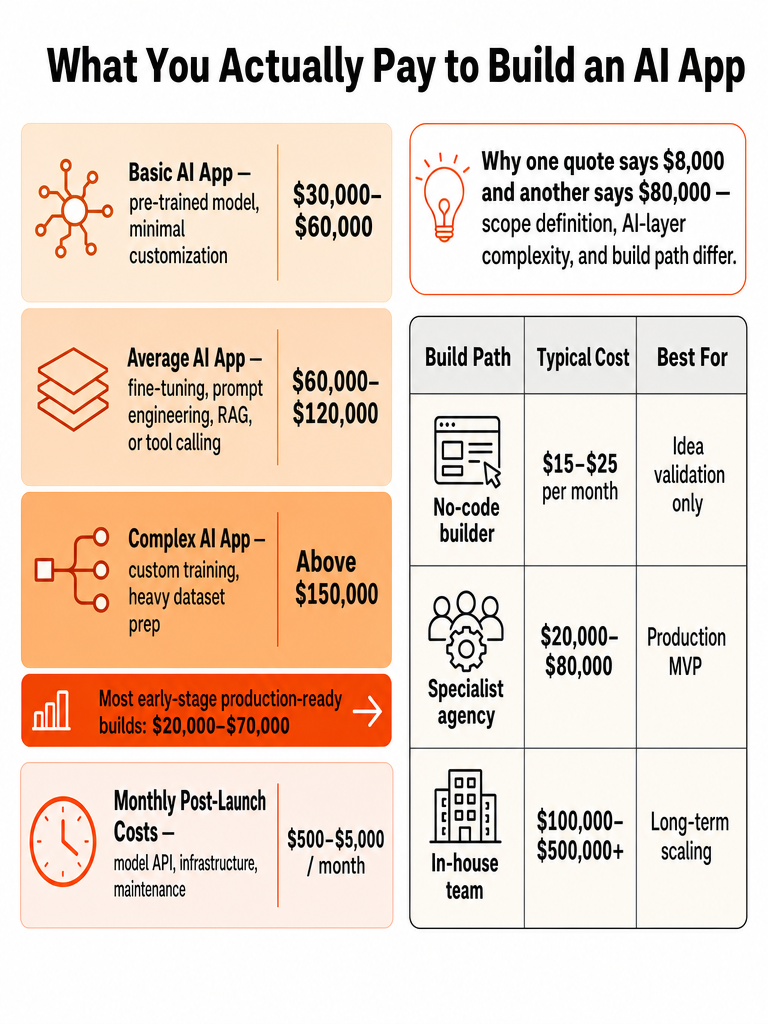
Why one AI MVP quote is $8,000 and another is $80,000
Two quotes for the same "AI MVP" can differ 10x because the teams are pricing different things. One means a single API call wrapped in a clean UI. The other means multi-user accounts, integrations, and a system that survives production traffic. Both call it an MVP. Neither is lying.
The confusion starts with three loaded words: MVP, production-ready, and integration. To a no-code builder, an MVP is a working demo. To a specialist agency, production-ready means auth, error handling, rate limits, and monitoring baked in. What one team ships as "done" is what another team calls "not started."
Integrations widen the gap fast. Connecting to Stripe for billing, Salesforce or Slack for workflow, or a customer's messy database is real engineering. Zite says larger applications with advanced features, higher security needs, or multiple integrations typically start at $100,000.
AI-layer complexity is the last multiplier. A prompt-only summarizer is cheap. Retrieval-augmented generation over your private docs, tool calling, and fine-tuning cost more. Before you compare quotes, force every bidder to define exactly what production-ready and integrated mean in their number.
What founders are paying to build an AI MVP in 2026
Founder-level AI MVP budgets in 2026 map cleanly to three outcomes. SpeedMVPs places a single-feature LLM tool at $8,000–$30,000, a multi-feature AI product at $30,000–$70,000, and most production-ready early-stage AI apps in the $20,000–$70,000 band when built by a specialist agency.
Here's what each budget actually buys.
- $8,000–$30,000: one narrow AI workflow. Summarization, classification, or a focused internal bot. SpeedMVPs says this ships in 2–3 weeks with a specialist. Good for testing a single hypothesis fast.
- $30,000–$70,000: a multi-feature product with several workflows, user accounts, and integrations. SpeedMVPs puts the timeline at 4–6 weeks. This is the realistic zone for a fundable first version.
- Above $70,000: you're leaving MVP territory and building a platform.
A lot of founders show up with around $30k and hear a quote that stops them cold. Here's the honest read: $30k builds a real, single-workflow AI app that works in production. It does not build a full SaaS platform. Match the budget to one outcome and let v2 handle the rest. For a deeper cut, see how to scope an AI SaaS MVP without wasting 6 months.
What is the average cost to develop an AI application by scope tier?
Scope tiers, not one blended number, are the honest way to read AI application cost. Uptech groups AI apps into three bands by complexity, and SpeedMVPs adds a four-tier build model with timelines. Reading both side by side is the fastest way to place your project.
Uptech's complexity bands:
| Tier | What it involves | Estimated fee |
|---|---|---|
| Basic AI app | Pre-trained model, minimal customization, chatbot or summarizer | $30,000–$60,000 |
| Average AI app | Fine-tuning, prompt engineering, RAG, or tool calling | $60,000–$120,000 |
| Complex AI app | Training from scratch, heavy dataset prep | Above $150,000 |
(Source: Uptech)
SpeedMVPs' build tiers add timeline and team size:
| Tier | Scope | Cost | Timeline |
|---|---|---|---|
| Tier 1 | Single-feature LLM tool | $8,000–$30,000 | 2–3 weeks |
| Tier 2 | Multi-feature AI product | $30,000–$70,000 | 4–6 weeks |
| Tier 3 | AI SaaS platform, multi-tenant, billing, advanced RAG | $70,000–$150,000 | 8–14 weeks, 3–5 engineers |
| Tier 4 | Enterprise system, custom-trained models, compliance/on-prem | $150,000–$250,000+ | — |
(Source: SpeedMVPs)
The two pages disagree at the floor. SpeedMVPs starts a usable AI app at $8,000; Uptech starts "basic" at $30,000. The difference is scope definition, not market reality. SpeedMVPs' Tier 1 is one workflow; Uptech's basic app assumes a broader deliverable. Pick your tier first, then the quotes stop looking random.
What factors affecting AI app development pricing actually move the number?
Five drivers move an AI app quote more than anything else: AI-layer complexity, model choice, data requirements, integrations, and security needs. SpeedMVPs says the most useful way to estimate cost is by the complexity of the AI layer rather than total feature count. That one lever explains most of the spread between a $10,000 and a $100,000 build.
Here's what each driver does to the number:
- AI-layer complexity: prompt-only is cheapest. RAG, tool calling, and agentic flows cost more because they add pipelines, retrieval, and error handling.
- Model choice: plugging into OpenAI, Claude, or Gemini keeps cost in the low thousands per year, per Zite. Custom training is where budgets explode.
- Data requirements: clean data is cheap; messy or unlabeled data is expensive.
- Integrations: every external system you touch is real engineering, not a toggle.
- Security needs: compliance, access control, and audit logging push you toward the Tier 3–4 range.
The complexity of the AI layer predicts your quote better than any feature list you write. Count the models, retrieval steps, and tool calls before you count the screens.
Agency vs no-code vs in-house: what should founders use for the first version?
For a first version, a specialist agency is usually the fastest path to a production-ready AI app; no-code is best for validation, and in-house is the most expensive early on. SpeedMVPs says in-house development is 3–5x more expensive than a specialist agency for the first version once salary, hiring time, and ramp-up are factored in.
| Path | Cost | Best for |
|---|---|---|
| No-code builder | $15–$25/month (Zite starts at $19/month) | Validating an idea, throwaway prototypes, single simple workflow |
| Specialist agency | $20,000–$80,000 for a small custom AI app on existing models | Production-ready first version, integrations, speed |
| In-house team | $100,000 for one engineer, $500,000+ for a team of 3–5 | Ongoing product ownership once you have traction |
(Sources: Zite, SpeedMVPs)
No-code builders are genuinely cheap and fast for testing. But no-code breaks the moment the workflow gets real, real users log in, or data matters. That failure point is covered in no-code vs custom AI tools: what breaks first.
Hiring a full in-house team before you've validated demand burns runway you can't get back. Founder salaries alone run $50k at pre-seed and climb to $150k+ at Series A (Source: OpenVC), before you've written a line of code. For version one, buy execution instead of headcount.
What pricing models for AI development services should founders expect?
Founders should expect three pricing structures from AI development services: fixed price, hourly, and monthly retainer. Fixed price suits a defined MVP with clear scope. Hourly fits open-ended discovery work. Retainers cover ongoing builds and maintenance after launch. Public, sourced benchmarks comparing these three models head-to-head are limited as of this writing, so treat any single "standard rate" claim with caution.
What the sources do support: the total build numbers in this article assume a defined-scope engagement, which usually means fixed price. That's the model that protects a founder budget best, because the risk of scope creep sits with the builder, not you.
If a vendor can only quote hourly for a well-defined MVP, that's a signal they haven't scoped it. Make them define the deliverable, then price it. When comparing agencies, the ongoing $500–$5,000/month operating cost (SpeedMVPs) usually lands under a retainer, so ask how they structure it before you sign.
How much will data prep, labeling, and integrations eat from the budget?
Invisible work — data prep, labeling, and integrations — can dominate an AI app budget before a single visible feature ships. Zite says data work alone can eat up 15–25% of the total budget. That's the line item founders forget when they compare a $30,000 quote to a $50,000 one.
Labeling costs scale with how specialized the data is. Zite puts simple supervised-learning labels at $0.03–$1 per label, and highly complex annotations, like medical images or legal documents, at $1–$3 per item. Multiply that across thousands of examples and the number stops being trivial.
On an average AI app, data work can cost more than the entire front end.
Integrations are the other silent budget drain. Connecting to a customer's existing systems, cleaning inconsistent records, and handling edge cases is engineering, not configuration.
This is the same trap that hits internal builds, covered in how much it costs to build an internal tool for your team.
When are existing model APIs enough, and when does custom training blow up the budget?
Off-the-shelf APIs cover the vast majority of AI apps, and custom training is what blows budgets past six figures. Zite says model usage lands in the low thousands of dollars per year when you design prompts and workflows well and use existing APIs from OpenAI, Claude, or Gemini. Custom training is a different universe of cost.
Here's the scale of that gap. Zite cites Claude Opus 4.6 at $5 input and $25 output per million tokens for standard requests. A small app handling 1,000 customer questions a day might run just $200–300/month in AI costs. That's your entire model bill for a working product.
Now the other end. Zite notes Meta trained its Llama 2 models on over 3 million GPU hours — roughly $3.8M in hardware usage alone if you rented NVIDIA A100s at $1.29/hour. Big tech negotiates far below retail; you won't.
Unless you're a lab, use existing APIs and spend the difference on product. Most apps never need training from scratch. Fine-tuning, RAG, and prompt engineering cover the customization founders actually want. Reach for custom training only when off-the-shelf models genuinely can't do the job, and confirm that first with a prototype.
What ongoing monthly costs hit after launch?
Operating cost recurs long after the build invoice clears — expect $500 to $5,000 per month for an AI app, according to SpeedMVPs, covering LLM API fees, infrastructure, maintenance, and monitoring. Founders who budget only for the build get surprised.
The four categories that hit:
- Model usage: every AI request costs a little. Zite's example of a small app handling 1,000 customer questions a day runs $200–300/month. Heavier usage scales up from there.
- Infrastructure: hosting, databases, and vector storage for RAG. Tools like Supabase sit here.
- Maintenance: bug fixes, model updates, and keeping integrations from breaking when APIs change.
- Monitoring: watching for failures, cost spikes, and degraded output quality in production.
For context on scale, one developer wrote in Medium that frontier AI dev tools now cost roughly $1,000/month per developer, up from the old $20/month plans. That's a build-side cost, not an app-running cost, but it signals where AI tooling spend is heading.
Model usage is usage-based, so it grows with your users. Factor that into unit economics before you price your product, or a viral month becomes a cash-flow problem.
Where AI app budgets overlap with internal tools, APIs, and MVP scope
AI app budgets overlap heavily with internal tools, custom APIs, and MVP scoping, because the same cost drivers — data, integrations, and production readiness — apply across all of them. Founders pricing an AI app are often really pricing one of these adjacent builds, and getting the category right saves money.
If your "AI app" is really a workflow tool for your own team, the internal-tool math applies. See how much it costs to build an internal tool for your team and custom internal tools vs spreadsheets: when to upgrade.
If the hard part is connecting systems reliably, you may need a custom API rather than a front-facing app. When you should build a custom API instead of using a no-code automation tool covers where that line sits.
If you're not sure whether you need a prototype or a full MVP, that decision changes the budget by an order of magnitude. Read AI prototype vs MVP: what founders should build first and AI-native MVP development: what founders actually need before committing a dollar. Naming the right build category cuts more waste than negotiating the quote.
How do you keep an AI app build inside budget without shipping a toy?
Keep an AI app inside budget by pricing the AI layer first, shipping one workflow, and protecting production basics while pushing extras to v2. SpeedMVPs' cheapest tier, a single-feature LLM tool, ships in 2–3 weeks for $8,000–$30,000 — proof that a narrow, real build beats a broad, half-finished one.
The checklist:
- Price the AI layer first. Model calls, retrieval, and tool use drive the quote more than screens. Estimate that before anything else.
- Ship one workflow, not five. Pick the single outcome that proves the idea. How to choose the first AI workflow to build gives you a scorecard.
- Use existing models. OpenAI, Claude, or Gemini keep model spend in the low thousands per year. Skip custom training until a prototype proves you need it.
- Protect production basics. Auth, error handling, and monitoring are not optional. Cutting these is what turns an MVP into a demo that dies under real users.
- Leave nonessential features for v2. Every deferred feature is budget you keep and a decision you make with real user data instead of guesses.
Do this and $30,000 buys a real AI app, not a prototype that impresses in a pitch and collapses in production. Cut scope, keep quality.
Let's build something real
Frequently asked questions
What is the pricing for an AI app development agency in 2026?
Specialist agencies charge $20,000–$80,000 to build a small custom AI app on existing models, according to Zite. Larger applications with advanced features, multiple integrations, or stricter security typically start at $100,000. On top of the build, plan for $500–$5,000 per month in ongoing API fees, infrastructure, and maintenance once the app is live.
What pricing models do AI development agencies use — fixed price, hourly, or retainer?
Fixed price protects a founder budget best on a defined MVP, because scope-creep risk sits with the builder. Hourly fits open-ended discovery work where scope can't be pinned down. Retainers cover post-launch maintenance and ongoing builds. The total build ranges cited in market research assume a defined-scope fixed-price engagement — if a vendor can only quote hourly for a well-scoped MVP, they haven't scoped it yet.
What factors affect AI app development pricing the most?
Five drivers dominate: AI-layer complexity, model choice, data requirements, integrations, and security needs. The complexity of the AI layer — whether it's prompt-only, RAG, tool calling, or agentic — predicts the final quote better than total feature count, per SpeedMVPs. Every external integration and compliance requirement pushes the build toward the $100,000+ range.
What is the average cost to develop an AI application by complexity tier?
Uptech puts a basic AI app (pre-trained model, minimal customization) at $30,000–$60,000; an average app with fine-tuning, RAG, or tool calling at $60,000–$120,000; and complex builds with custom-trained models above $150,000. SpeedMVPs starts lower — a single-feature LLM tool runs $8,000–$30,000 in 2–3 weeks — because its Tier 1 covers one narrow workflow, not a full deliverable.
How much does data prep and labeling add to an AI app budget?
Data work alone can consume 15–25% of the total project budget, per Zite. Simple supervised-learning labels run $0.03–$1 per item; complex annotations like medical images or legal documents cost $1–$3 per item. Across thousands of training examples, that line item often exceeds the entire front-end build cost — and any quote that ignores it will change mid-project.
When do off-the-shelf model APIs stop being enough and custom training blow up the budget?
Off-the-shelf APIs from OpenAI, Claude, or Gemini cover the vast majority of production AI apps and keep model spend in the low thousands of dollars per year. Custom training is a different category entirely — Meta's Llama 2 consumed over 3 million GPU hours, roughly $3.8M in hardware alone at retail A100 rates, per Zite. Use fine-tuning, RAG, and prompt engineering first; only reach for custom training after a prototype proves the existing models genuinely can't do the job.
Sources
- AI App Development Costs & How To Pay Less [2026 Guide]dwkerwin.medium.com
- $1K/Month Per Developer: The AI Cost Nobody's Prepared Forwww.youtube.com
- How Much Does Building an AI App Actually Cost in 2025?www.openvc.app
- How Much Should Startup Founders Pay Themselves [2026]www.uptech.team
- AI app development cost (Estimates & Ways to Reduce)speedmvps.com
- What Founders Pay for an AI MVP 2026 | SpeedMVPsspeedmvps.com