

Drop Real Asteroids.See The Destruction.
An interactive impact simulator built on real science. Select any near-Earth asteroid from NASA's CNEOS catalog, click anywhere on the globe, and watch destruction zones render in real time using the same physics framework as Purdue University's Impact Earth tool.

The Actual Interface.
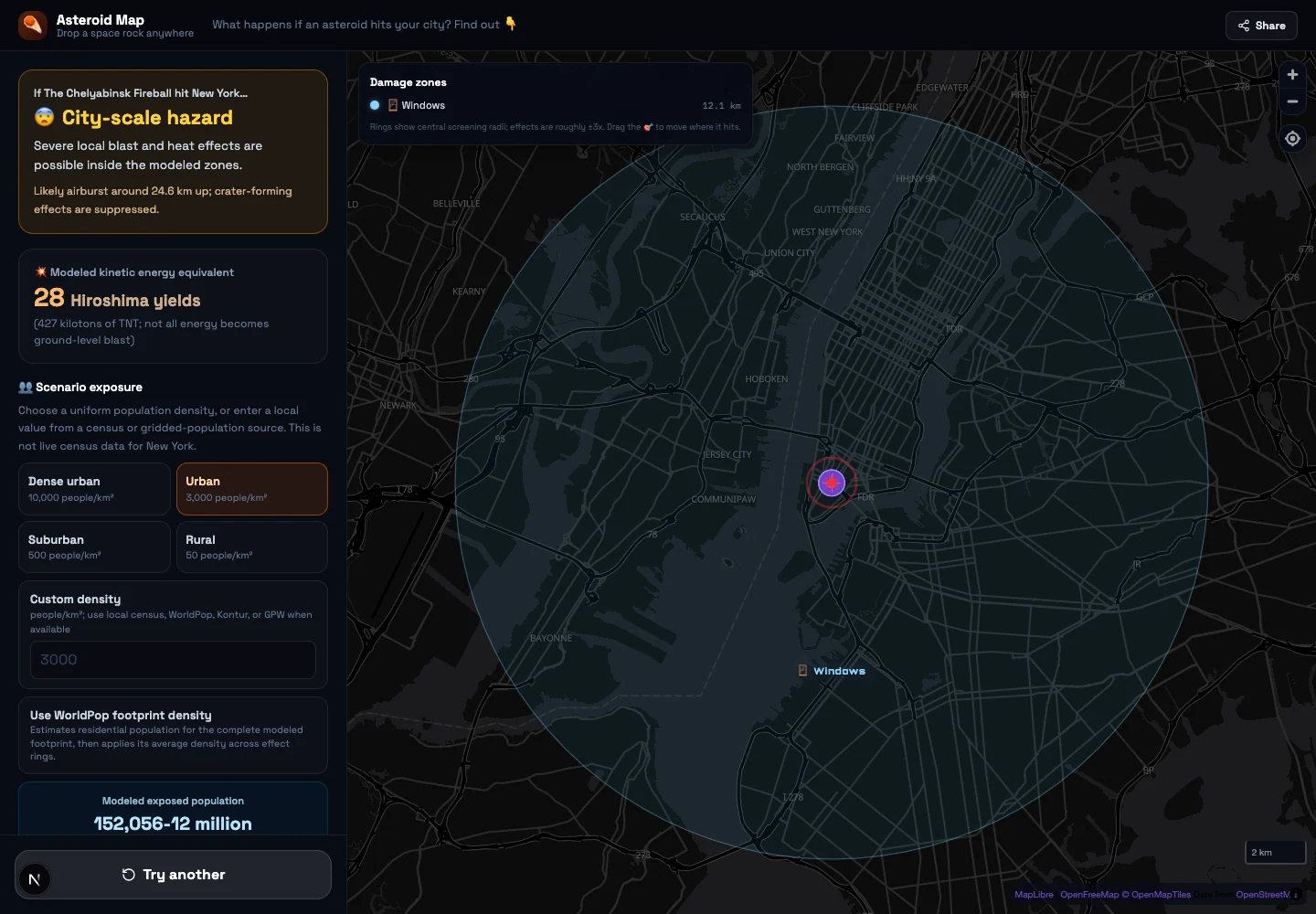
Impact Science Is Locked Inside Academic Tools.
The physics for modelling an asteroid impact is published and well understood, but reading it is not the same as seeing it. The scale of a crater, a fireball or an air blast only becomes legible when it is drawn over a place you know.
Asteroid Map puts a real catalogue and a real physics model behind one interaction: pick an asteroid, click a point on Earth, watch the zones render.
Real Data, Real Physics, Real Globe.
MapLibre GL globe. A full interactive 3-D globe. Users click any point on Earth to set the impact site, then watch layered destruction rings render at scaled radii in real time.
NASA JPL CNEOS API. A live near-Earth asteroid feed: mass, diameter, composition, approach velocity and impact probability pulled directly from JPL's Center for Near Earth Object Studies.
Collins et al. 2005 impact physics. The same scientific framework as Purdue's Impact Earth. It models crater radius, fireball zone, thermal radiation radius, seismic effects and air blast wave from first principles.
Fully public on GitHub. Every line of the physics model, API integration and globe renderer is open source. Fork it, audit it, extend it.
Four Effects, Each Computed From First Principles.
Crater radius. Transient and final crater diameter computed from impactor kinetic energy, target density and impact angle.
Fireball zone. The radius within which the fireball causes third-degree burns on exposed skin, scaled to impactor energy and atmospheric entry velocity.
Thermal radiation. Thermal fluence at distance, ignition of combustibles, second-degree burn threshold and first-degree burn threshold, rendered as concentric rings.
Seismic and air blast. Richter-scale equivalent seismic magnitude and overpressure wave, with structural damage thresholds mapped to distance from the impact point.
- MapLibre GL
- Next.js
- NASA JPL CNEOS
- Collins et al. 2005
Let’s Build What’s Next.
Bring the business problem. We’ll talk through what would make a difference and where to start.