

Repo Health At A Glance.Docs Written From The Code.
BAX connects to your repos, tracks health metrics, and generates documentation whenever you need it. Not from templates, from the code itself.

The Actual Interface.
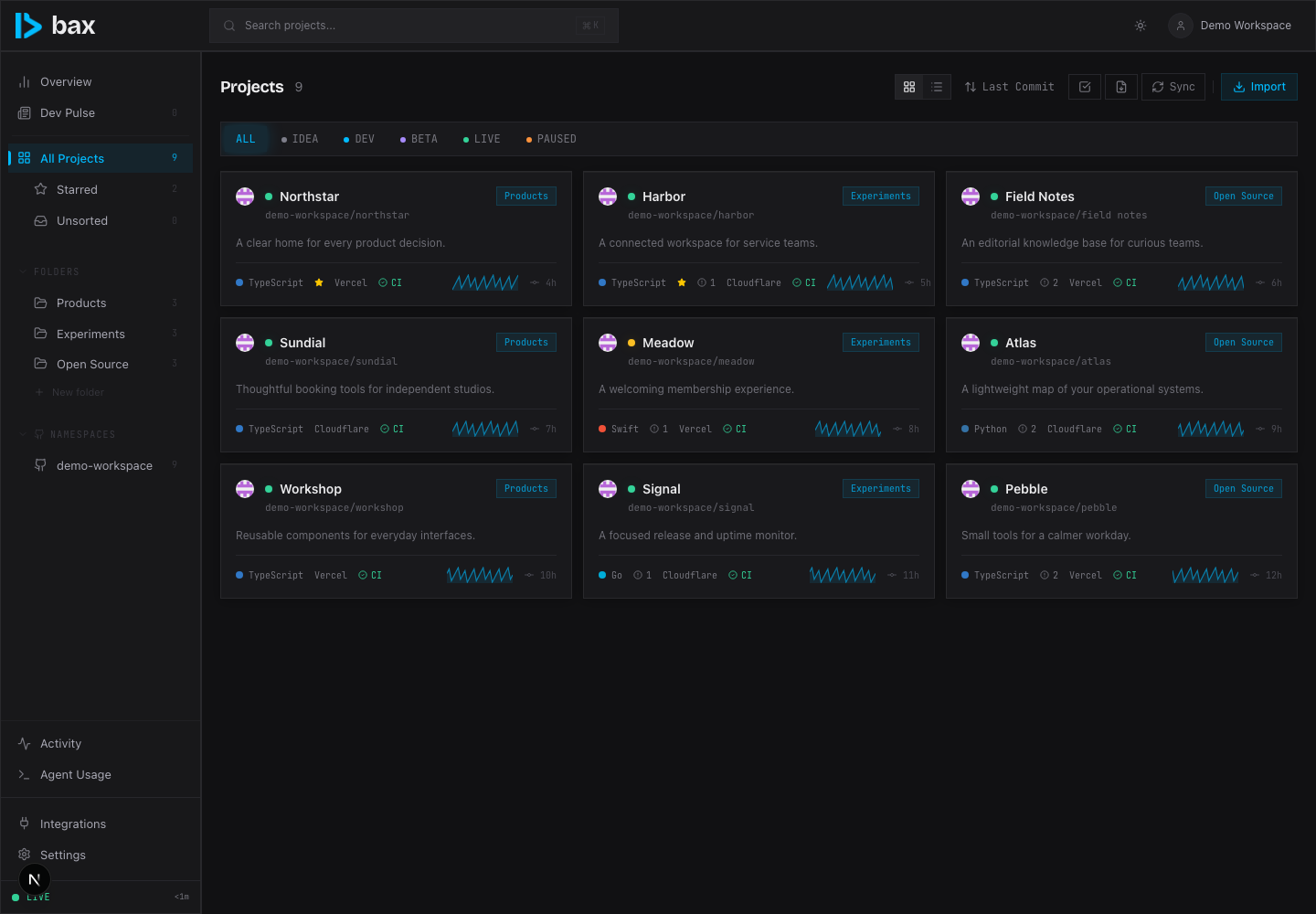
Every Developer Knows The Documentation Is Out Of Date.
Docs drift the moment the code moves. Rewriting them is the task that gets deferred every sprint, because it produces nothing a user can see and it goes stale again a week later.
BAX fixes that by connecting directly to GitHub, monitoring what is actually in the codebase, and generating accurate docs on demand from the code itself.
Health Metrics And AI Docs In One Dashboard.
Repo health, five signals. Commit velocity, open PR age, stale branch count, test coverage trend and dependency vulnerability count, surfaced as a unified health score per repo. GitHub webhooks keep every metric live without polling.
The model reads the code and writes the docs. Select any file, module or open PR and request docs. The model reads the actual code and generates inline JSDoc, module-level READMEs or a full API reference, in the appropriate format for the language and context. No hallucinated APIs.
Trigger.dev durable tasks. Doc generation is queued as a durable background task, so large codebases, the ones that would time out an HTTP request, generate reliably. The job retries on failure without re-triggering the model call from scratch.
tRPC end to end. All communication between the Next.js frontend and the backend services runs through tRPC. Types are shared across the boundary, so there are no REST contracts to maintain and no manual type assertions.
Generation, Integration And Orchestration.
Generation. File content is fetched from the GitHub API and passed directly to the model with a structured prompt that specifies output format, JSDoc, README markdown or OpenAPI fragment, based on the selected file type and user intent.
GitHub OAuth and webhooks. OAuth connects repos without storing credentials. Push and PR events arrive via webhooks and update health metrics in real time, so commit velocity and PR age stay accurate without scheduled polling jobs.
Orchestration. Each doc generation request is a durable Trigger.dev task with automatic retries and step-level checkpointing. Large monorepos generate full documentation suites with no request timeout concerns.
- Next.js
- tRPC
- Trigger.dev
- Language model
- GitHub API
- Supabase
Let’s Build What’s Next.
Bring the business problem. We’ll talk through what would make a difference and where to start.