

Autonomous SEO That Writes,Reflects, And Publishes.
A seven-stage agentic pipeline that produces long-form content at scale, plus a GEO engine tracking 10 AI search engines. Multi-tenant, with isolated brand profiles, keyword targets and tone guidelines per client.

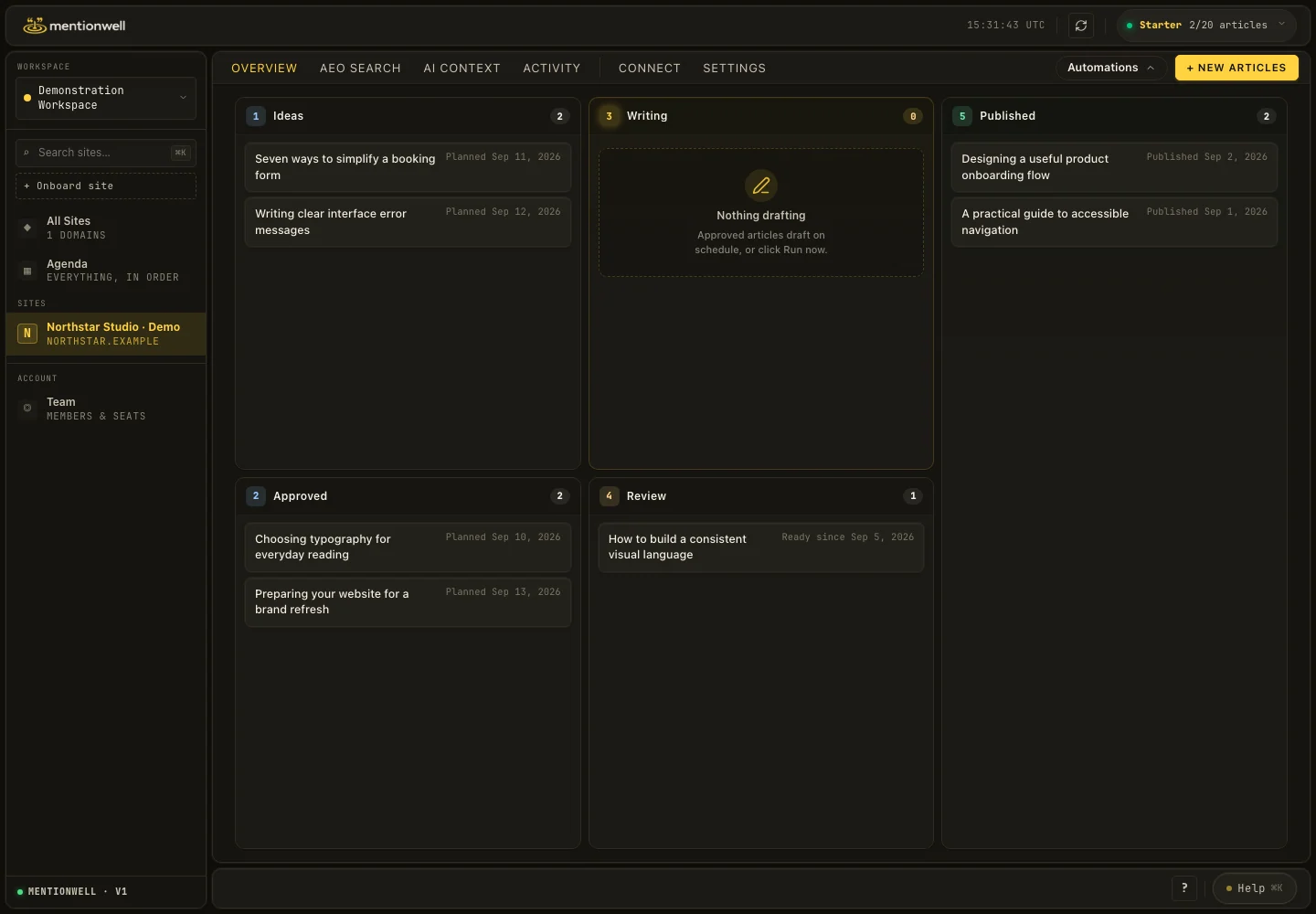
The Actual Interface.
Content At Scale Usually Means Thin Content.
The usual way to publish more is to lower the bar: shorter briefs, less research, no second read. What comes out ranks for nothing and reads like it.
Every article MentionWell produces passes through a seven-stage autonomous pipeline instead: research, outline, draft, reflect, refine, image, publish. No human bottleneck, no copy-paste, no thin content.
Seven Stages, Plus A GEO Engine On Top.
Stages 01 and 02, research and outline. Serper pulls live SERP data for target keywords. Firecrawl scrapes top-ranking pages for structure and coverage signals. An outline agent synthesises a content brief with heading hierarchy and target word counts per section.
Stages 03 and 04, draft and reflect. A draft model writes the full article against the brief. A second model pass, the Reflect stage, reviews the draft for factual gaps, thin sections and missing search intent coverage, producing a structured critique that feeds directly into stage 05.
Stages 05 to 07, refine, image and publish. The refine agent rewrites flagged sections. An image model generates a unique header image matched to the article topic and brand palette. A CMS publishing agent delivers the final article, with SEO metadata, slug, alt text and structured data, directly to Webflow or a client API.
The GEO engine. A proprietary module queries 10 AI search engines, ChatGPT, Perplexity, Claude, Gemini, Copilot and more, with branded queries on a schedule, measuring citation frequency, sentiment and share of voice across AI platforms over time.
Isolated client profiles. Each client runs in a fully isolated profile: brand voice guidelines, keyword targets, competitor watchlists, tone instructions, publishing credentials and CMS config. One platform, zero cross-contamination.
Dashboard. A real-time article status tracker across all seven stages, keyword ranking history, GEO citation score over time per AI engine, and a scheduled publish queue with override controls.
The Reflect Step Is What Keeps The Quality.
Reflect is the single most impactful stage in the pipeline. After the first draft is written, a second model is invoked with the draft, the original brief and a critique rubric. It returns a structured JSON object identifying:
- Sections with factual claims that need verification
- Headings where search intent is underserved
- Word count deficits by section against the SERP average
- Missing semantic keywords identified from competitor coverage
- Tone deviations from brand guidelines
Model routing. Pipeline stages run on different models: heavier models for Draft and Reflect, faster models for Outline and metadata generation. Routing rules are per-client and configurable without code changes.
Orchestration. Trigger.dev runs the job queue and retry logic, Supabase holds client profiles and article state, a routing layer picks the model per stage, and an image model generates the artwork.
- Next.js
- Multi-model routing
- Image generation
- Firecrawl
- Serper
- Supabase
- Trigger.dev
- Webflow API
Let’s Build What’s Next.
Bring the business problem. We’ll talk through what would make a difference and where to start.