

17 Steps. Full Site.Fully Automated.
The internal multi-step agent platform that researches, designs, builds and deploys full websites end to end. Not a generator and not a template engine: a full agentic pipeline that goes from brand brief to deployed site without a human touching code. Internal, not publicly available.

The Actual Interface.
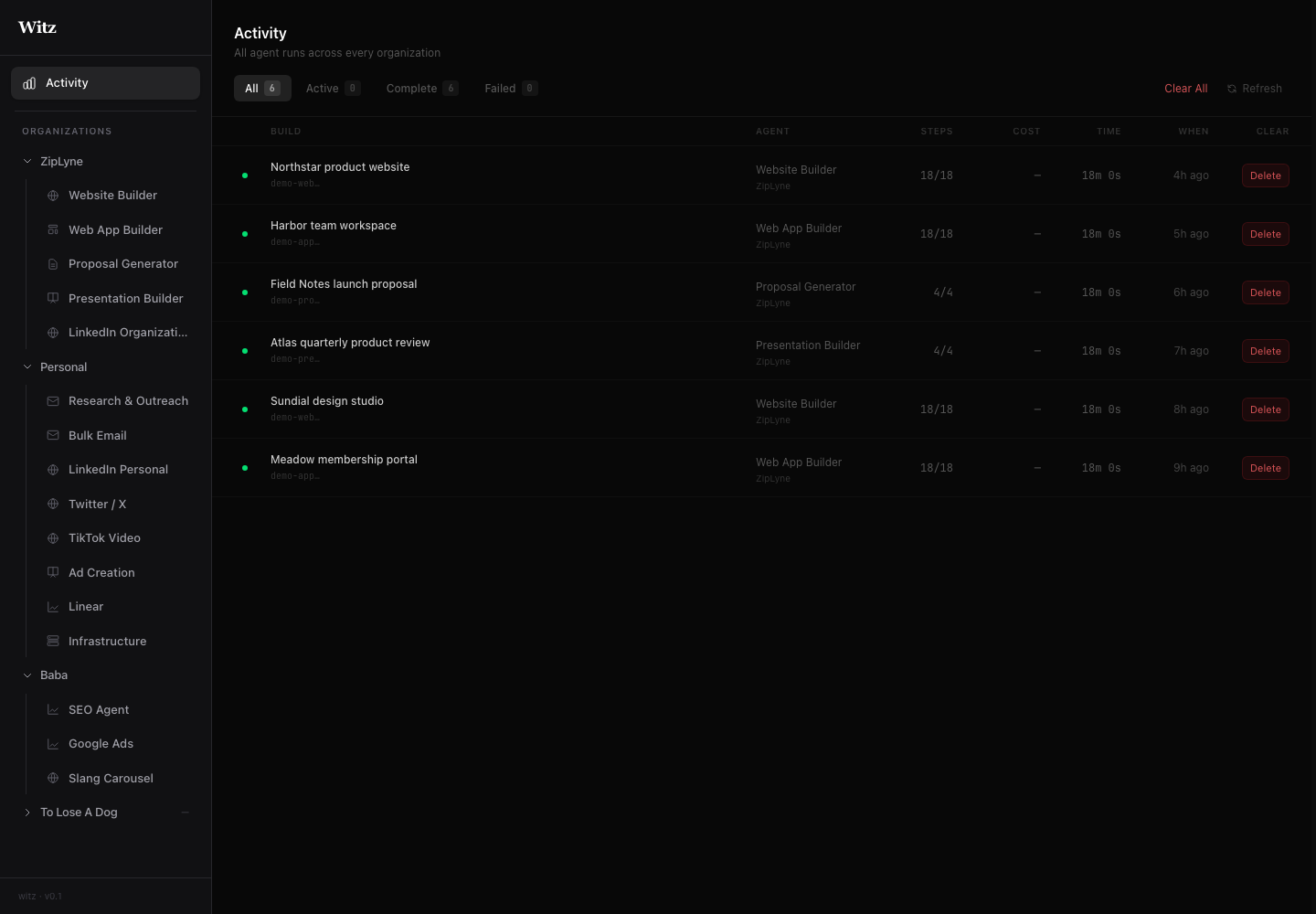
Shipping Fast Is A Pipeline Problem, Not A Talent One.
A client site is the same sequence of decisions every time: research the brand, read the competitors, decide the pages, write the copy, set the tokens, build the components, ship it, then keep it fresh.
This is the system that lets ZipLyne ship at the velocity we do. Two pipelines: WB2 for builds, WA1 for ongoing content.
Two Pipelines, Build And Maintain.
WB2, Website Builder 2, 17 steps. Brand research, competitor analysis, sitemap generation, copy writing, design spec, component scaffolding, page implementation, SEO optimisation, deployment. Each step is a structured model call, and the output of step N is the input to step N+1.
WA1, Website Automator 1, 18 steps. The post-deploy content engine. It generates blog posts, updates landing page copy, refreshes meta descriptions and submits to search indexes, running on a schedule or on trigger. 18 steps, all durable. The site stays fresh without anyone touching it.
Durable by default. Every pipeline step is a Trigger.dev v4 durable task. Step failures retry automatically without restarting the whole chain, steps can be replayed individually during debugging, and a 17-step build can be paused at step 9 and resumed with no data loss.
Right model, right step. A reasoning model handles copy and implementation steps. A faster, cheaper model handles structured data extraction and research. A routing layer selects the model per step based on task type, with automatic fallback for rate limits.
From Brief To Deployed Site.
- Step 01, brand research: competitor crawl, positioning analysis, tone profile
- Step 02, competitor analysis: feature matrix, gap identification, differentiation brief
- Step 03, sitemap generation: pages, hierarchy, content types, structured output
- Step 04, copy writing: hero, sections and CTAs, in brand voice
- Step 05, design spec: colour system, type scale and spacing, with the model generating tokens
- Step 06, component scaffold: file structure, component list, prop interfaces
- Step 07, page implementation: full Astro or Next.js page code, whole files rather than snippets
- Step 08, SEO optimisation: meta, OG tags, schema markup, sitemap.xml
- Step 09, QA pass: broken links, missing alt text, contrast ratio checks
- Step 10, deployment: the Vercel deployment API, with the live URL returned to the pipeline
Steps 11 to 17. Analytics, performance, accessibility, redirects, DNS, monitoring and handoff. Post-deployment hardening, GA and GTM injection, a Lighthouse pass, and a structured handoff brief for the client.
- Reasoning model
- Extraction model
- Multi-model routing
- Trigger.dev v4
- Elysia / Bun
- Next.js
- Vercel API
Let’s Build What’s Next.
Bring the business problem. We’ll talk through what would make a difference and where to start.