

250+ Pages. 4 Languages.Every Image Generated.
Full brand, design and build for a cenote and scuba operator in Mexico. Ground-up rebuild with SEO and AEO optimised pages: first page of Google, cited by ChatGPT and Claude, bookings up over 200%.

The Actual Interface.
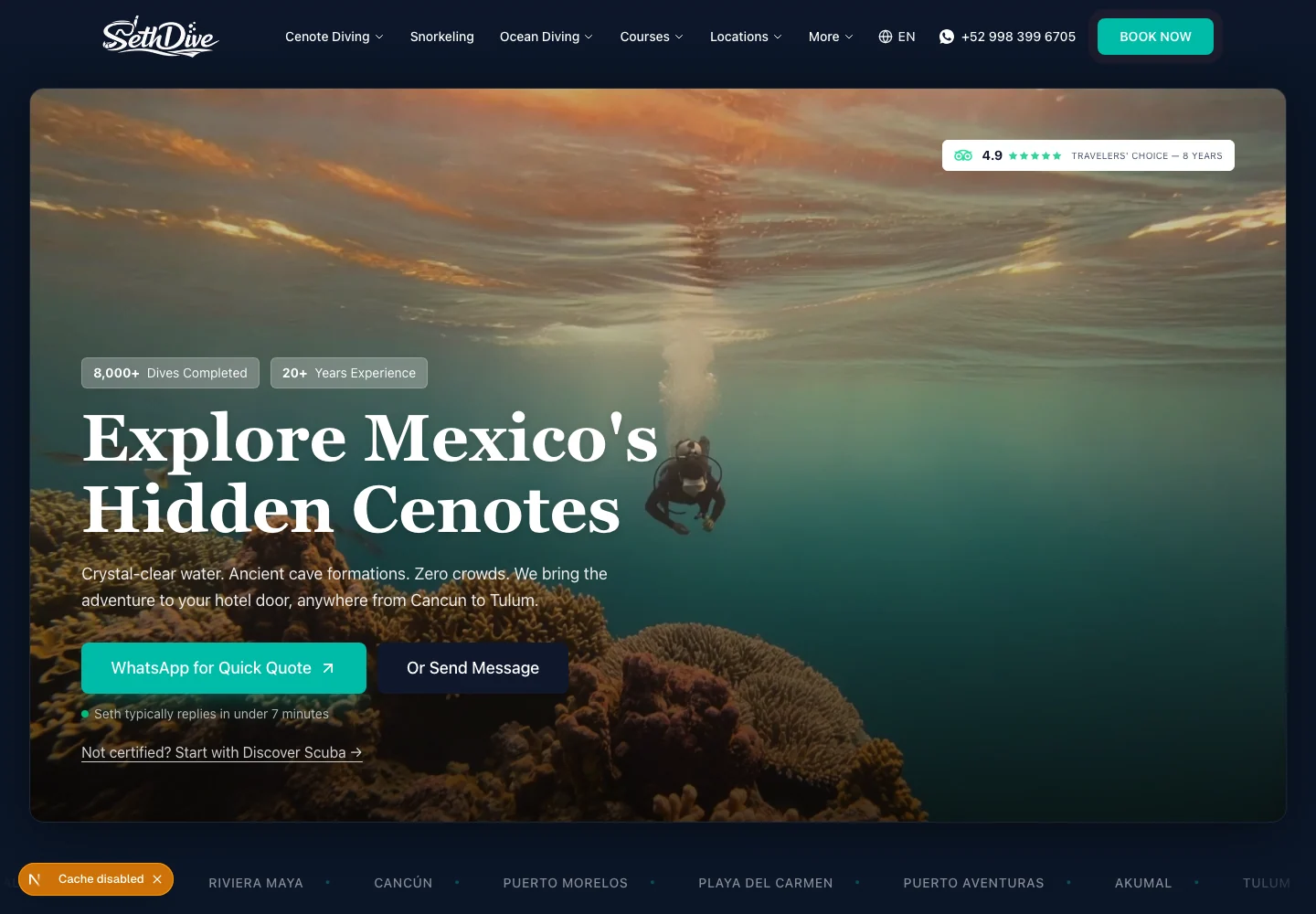
A Dive Shop Cannot Out-Publish A Booking Platform By Hand.
Seth Dive needed everything: brand, photography, content strategy, site architecture and engineering. The market it sells into, the Yucatán, is served in four languages and searched one dive site, one cenote, one certification level at a time. Writing that catalogue by hand, in four languages, is a full-time job nobody at a dive shop has.
Travel photography is the second wall. The traditional path is hiring local photographers, scouting locations, pulling permits, waiting on weather, then paying for post-production, all before a single page goes live.
Every Page And Every Image, Generated From A Schema.
Programmatic SEO. Every dive site, cenote, course, certification level and location combination gets its own fully optimised page with structured data, unique meta descriptions, hreflang tags and language-specific sitemaps. Pages are generated at build time from a structured content schema, so adding one new dive site creates four localised pages automatically.
Four-language i18n. English, Spanish, German and French, covering the major tourist demographics in the Yucatán market. Translations are AI-assisted through next-intl and a custom translation pipeline, then human-reviewed. Each language gets its own sitemap, hreflang graph and meta tags, with URL structure respecting language prefixes in Next.js routing.
The image pipeline. 40+ generation scripts replaced the photography workflow outright. A vision model analysed reference images of the real locations and wrote prompts that captured the specific light, water colour and environmental character of each site; those prompts fed the image models for final generation. What came out:
- Location photography replacements: cenotes, reefs, caverns
- Underwater scene composites with divers and marine life
- Instructor portrait series with brand-consistent styling
- Equipment and certification card imagery
Every generated asset went through a Cloudinary pipeline before it reached the site: AVIF with a WebP fallback, responsive srcsets at five breakpoints, global CDN delivery, and 300+ assets in total, with no manual step in the middle.
The Catalogue Indexes Itself And The Funnel Is Instrumented.
Indexing on publish. The IndexNow API, the Google Search Console API and the Bing Webmaster API are all called automatically whenever a new page publishes, so programmatic pages are discovered in hours rather than weeks. The sitemap is regenerated and resubmitted on every deploy.
Conversion, measured. A custom GA4 dashboard shows the booking funnel in real time, with traffic-to-inquiry conversion broken out by language and entry page. An exit-intent system watches scroll depth plus mouse-leave and fires a contextual CTA. Certification pages get a different hook than cenote day-trip pages.
Video that does not cost the page. Underwater footage plays inline without hurting Core Web Vitals: Mux Player is lazy-loaded behind a poster image until the visitor scrolls to it, so video never blocks the initial render.
- Next.js
- Cloudinary
- Mux Video
- next-intl
- GA4
- IndexNow + GSC API
- Image generation models
- Vision model
Let’s Build What’s Next.
Bring the business problem. We’ll talk through what would make a difference and where to start.