


Custom CRM vs HubSpot in 2026: when does each one win?
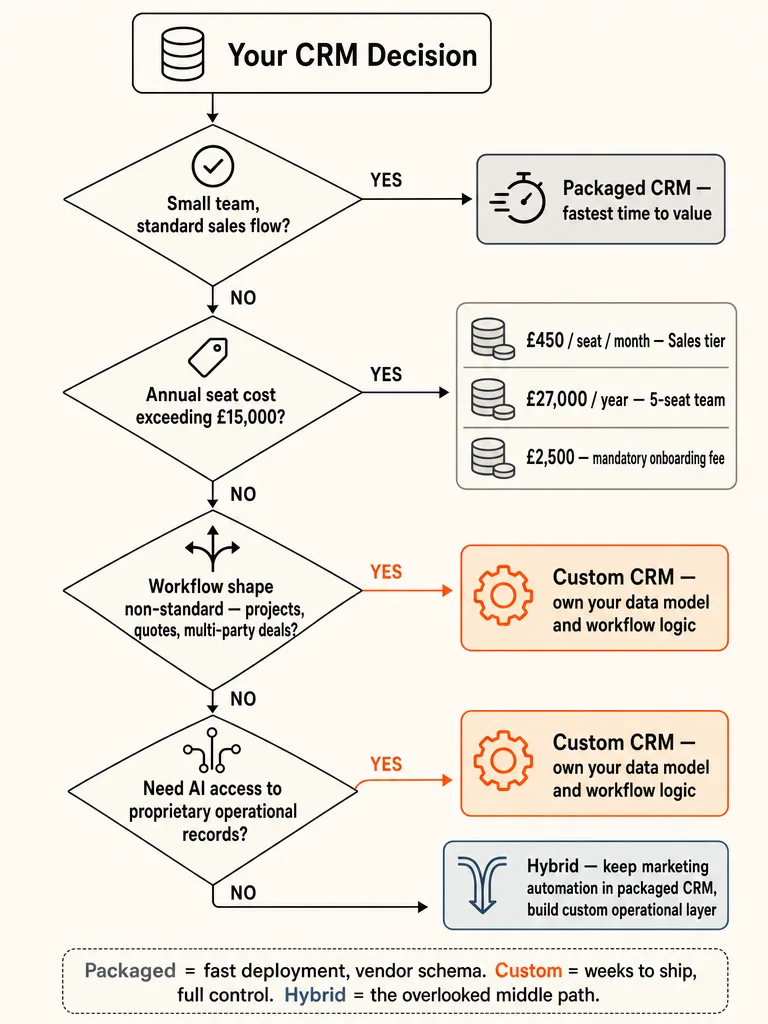
Custom CRM vs HubSpot is a fit-and-cost call, not a taste call. HubSpot wins when your sales process is standard and you need something live this week. Custom wins when your workflow shape, integrations, data ownership, or per-seat cost breaks the packaged model. And often the real answer is hybrid: keep one, build the other. LGP.dev puts HubSpot Sales Hub Professional at £450 per seat per month in its April 2026 snapshot (figures below reflect each source's own market, so watch the currency).
Here's the blunt version. If you're a five-person team running lead → qualified → proposal → closed, HubSpot, Pipedrive, or Zoho will get you selling faster and cheaper than any build. Off-the-shelf deploys in days. A custom CRM takes weeks, per Aunimeda.
But that math flips. Seganiko says a standard CRM is enough in 80% of cases, and unbeatable at 10 to 15 users. The tipping point toward custom generally shows up between 25 and 35 users, or the day your workflow stops fitting the pipeline everyone else uses.
The decision comes down to four breakpoints: seat count, workflow shape, data-model ownership, and whether AI needs clean access to your records.
The rest of this article walks each one with real numbers, so you can decide whether to stay in HubSpot, build around it, or replace it entirely.
What does HubSpot actually cost once you're set up?
HubSpot's real cost is 10 to 20 times its sticker price once you reach the tier growing teams actually need. The $20-per-seat Starter number is a lie of omission. The moment you need workflows, sequences, custom reports, and marketing automation, you're on Professional or Enterprise. For a US-audience gut check, Projek IA estimates a 15-person company on both hubs realistically spends $30,000 to $50,000 CAD a year, forever, and a 30-seat company gets closer to $80,000.
The UK numbers tell the same story. LGP.dev lists Sales Hub Professional at £450 per seat per month and Marketing Hub Professional starting at £660 per month. Stack those two for a five-person team and you're at roughly £15,000 per year before anyone sends an email. Its pricing table puts a five-seat team on Sales Hub Professional at £27,000 per year, with Enterprise pushing that to £60,000.
| HubSpot tier | Per seat / month | 5-seat team / year |
|---|---|---|
| Starter | £18 | £1,080 |
| Sales Hub Pro | £450 | £27,000 |
| Sales Hub Enterprise | £1,000 | £60,000 |
| Onboarding (one-off) | £2,500 | — |
The seat math is the trap. HubSpot bills per paid seat, so anyone who edits records or runs reports needs a license. Projek IA says it audited companies paying for 25 paid seats when only 8 people used the platform daily. Onboarding on Pro+ tiers is mandatory, running $1,500 to $7,000 USD depending on tier.
At what point does a custom CRM beat HubSpot on cost?
A custom CRM starts beating HubSpot on cost once your annual license spend climbs into upper-tier territory, generally somewhere in the 25-to-50-user range. Below that, subscription cost stays manageable and building doesn't pencil out. Above it, per-seat licensing compounds while a custom build's cost stays roughly flat. LGP.dev says a custom CRM at £10,000–£15,000 build cost plus £80 per month hosting starts beating HubSpot inside year one once annual HubSpot spend crosses roughly £20,000 to £25,000.
The 3-to-5-year math is where it gets stark. Seganiko estimates 50 users over three years can mean €150,000 to €300,000 in CRM licenses. At those seat counts, a custom build pays back development in 12 to 18 months.
| Path | Build / license cost | Ongoing |
|---|---|---|
| HubSpot, 5 seats (LGP.dev) | £27,000/yr | recurring, forever |
| HubSpot, 50 users, 3 yrs (Seganiko) | €150,000–€300,000 | recurring |
| Custom CRM (LGP.dev) | £5,000–£15,000 once | £80/mo hosting |
| Custom CRM (Projek IA) | $25,000–$80,000 CAD once | under $200/mo hosting |
Projek IA puts a focused custom build at $25,000 to $80,000 CAD, shipped in 8 to 16 weeks, with hosting after the build often under $200 a month.
How standard does your sales process need to be for HubSpot to fit cleanly?
If your pipeline runs lead → qualified → proposal → negotiation → closed, HubSpot fits cleanly and building is a waste of money. That's the honest test. Seganiko says most companies' commercial processes look like their competitors': prospecting, qualification, opportunity, quote, negotiation, signing, follow-up. SaaS CRMs encode exactly that logic, and they're ten years ahead of any in-house build on UX and standard automation.
Before you decide your process is special, run one gut check. Seganiko names the real trap directly:
The trap is to confuse "our process is unique" with "our process isn't in the HubSpot manual." Most of the time, the process isn't unique. It's just different. And a well-configured standard CRM handles it.
Modern CRMs are extensible. HubSpot has a solid API, Salesforce has a platform, and both support custom objects, fields, and workflows without touching the core. For most "specific to my company" needs, a configuration already exists in HubSpot, Pipedrive, Zoho, Salesforce, or monday CRM.
Before you scope a build, prove your process is truly non-standard, not just under-configured. If you've spent 18 months on HubSpot still running your real deals in Excel on the side, that's a fit signal worth taking seriously, per Seganiko.
Is your CRM tracking deals, or contracts, cases, quotes, and projects?
Custom CRM pulls ahead when your business doesn't revolve around deals at all. It revolves around contracts, legal matters, quotes with complex line items, project records, or multi-party B2B2C relationships that don't map to a vendor's schema. Caspio frames it plainly: build when your pipeline, stages, or record types don't map cleanly onto Salesforce or HubSpot, and you're tired of paying for fields you don't use while fighting the ones you need.
This is the issue competitors gloss over. Off-the-shelf CRMs assume a deal object sits at the center. Aunimeda points to legal matter management, construction project tracking, and healthcare compliance workflows where off-the-shelf bends badly. In those businesses, the record you actually manage all day is a matter, a job site, or a signed agreement, not a sales opportunity.
LGP.dev puts the payoff in hours: in non-standard workflows, a bespoke CRM modeling exactly how you operate can save 5 to 15 hours of admin per week per rep from year two onward. That's the difference between a tool your team works with and one they work against.
When is the hybrid pattern better than pure HubSpot or pure custom?
Hybrid is often the actual best answer, and most comparison pages never mention it because it pays agencies less. The pattern: keep HubSpot for marketing automation and generic sales engagement, then build a custom operational layer for the workflow that makes your business different. Visual-AI-Labs reports that of its engagements starting as HubSpot-vs-custom decisions, about 40% ended on HubSpot alone, 35% on hybrid, and 25% on custom CRM.
That means a hybrid setup was the right call more often than a full custom build. You don't rip out HubSpot's email campaigns, attribution, and sequences. That stuff is strong and expensive to rebuild. You extend it.
Here's when hybrid beats either pure path:
- Your marketing is standard but your operations aren't. HubSpot runs the funnel; a custom layer runs quoting, project delivery, or fulfillment.
- You want to stop the per-seat bleed on ops staff. Read-heavy operations users live in the custom layer with no HubSpot license, killing the 25-seats-for-8-users problem Projek IA flagged.
- You need clean data flowing both ways so marketing and delivery aren't two disconnected systems.
The trade-off is integration work and two systems to maintain. But you keep HubSpot's fastest features while owning the part that actually differentiates you. For a lot of growing teams, that's the honest middle.
Want this built right the first time? Let's build something real.
Should AI workflows push you toward custom CRM or hybrid?
If your AI workflows need clean, structured access to contacts, companies, deals, activities, and your proprietary operational records, owning or extending the data model matters more than adding another SaaS feature. AI is only as good as the data it can reach. Caspio describes a custom CRM as a real relational structure linking contacts, accounts, deals, and activities the way your business defines them, not the way a vendor's schema assumes.
That relational control is what changes the AI calculation. When a model needs to pull a quote history, cross-reference a project record, and check an email thread from Gmail or Outlook in one query, a schema you own answers cleanly. A packaged CRM answers only within the fields and API limits the vendor allows.
Aunimeda makes the adjacent point on integration: building connectors to proprietary systems, legacy ERP, or industry software inside Salesforce is often more expensive than building the CRM itself. AI raises the stakes because those connections have to stay reliable in production, not just work in a demo.
This isn't a reason to torch HubSpot. It's a reason to consider hybrid: keep the marketing engine, build the data layer AI actually reads from. If you're deciding what to wire up first, our guide on building AI systems around your workflows covers the sequencing.
What maintenance costs hit after a custom CRM ships?
A custom CRM's real cost isn't the build, it's the years after. Once it ships, you own support, security updates, feature changes, bug fixes, and the internal responsibility for all of it. Seganiko says a €30,000 custom CRM easily costs €6,000 to €12,000 per year in maintenance, security updates, evolutions, and support, reaching €60,000–€90,000 total over five years.
That's the number sales-driven build pitches leave out, and it's the honest counterweight to every cost table above. A HubSpot subscription bundles hosting, security, uptime, and continuous feature updates into the monthly fee. A custom CRM hands all of that to you.
The trade-off still favors custom at scale, because maintenance stays roughly flat while seat licensing keeps climbing. Projek IA puts post-build hosting often under $200 a month. But hosting isn't maintenance. Someone has to own the codebase, respond when something breaks, and ship changes as the business shifts.
Don't build custom unless you're prepared to fund ownership for the full 3-to-5-year window, not just the launch. If you can't commit to that budget or a partner who maintains it, HubSpot or a hybrid setup is the safer bet. Migration and lock-in cut both ways, and rebuilding a neglected custom CRM in year three costs more than the original.
Should you build on Caspio, Zoho Creator, Knack, Quickbase, Airtable, Power Apps, Bubble, or a custom stack?
Your build path is a trade-off between speed and control. No-code and low-code CRM builders get you live fastest with less engineering; a custom stack gives you full ownership of the data model and scaling. Caspio ranks the strongest 2026 no-code/low-code options as Caspio, Zoho Creator, Knack, Quickbase, Airtable, Microsoft Power Apps, and Bubble, and says Caspio leads for database-grade, secure, scalable CRMs with unlimited users, built on Microsoft SQL Server hosted on AWS.
The other path is a real code stack. LGP.dev says modern stacks using Postgres, Supabase, React, and Next.js, plus AI-assisted code generation, cut development time roughly in half versus 2020, which is how bespoke SMB CRMs now land at £5,000–£15,000 instead of £40,000+.
| Path | Best for | Trade-off |
|---|---|---|
| No-code (Airtable, Knack, Bubble) | Fastest launch, small teams | Limits show as workflow gets real |
| Low-code (Caspio, Quickbase, Power Apps, Zoho Creator) | Secure, multi-user, unlimited seats | Platform pricing and ceilings |
| Custom stack (Postgres, Supabase, React, Next.js) | Full ownership, AI access, scale | You own maintenance |
No-code is fast until the workflow gets serious. For where those cracks appear, see our breakdown on no-code vs custom AI tools and what breaks first.
Which internal tools and automations should connect to the CRM first?
Connect the workflows that touch money and manual cleanup before you add another seat or rebuild anything. Lead intake, invoicing, follow-up, and reporting are the lanes leaking the most hours, so they're where an integrated CRM pays back fastest. The order matters more than the tool: fix the process bleeding revenue first, then stack the rest.
A useful sequence for a growing team:
- Lead intake to CRM. Kill manual re-entry so no lead sits in an inbox. This is the workflow our AI workflow automation guide for SMBs starts with, because it feeds everything downstream.
- Quoting and invoicing. Where the deal record becomes money, wire it tight.
- Follow-up and reminders. Automated, not remembered.
- Reporting. Pull from the live data model, not exported spreadsheets.
Before you build a custom API for any of this, run the failure test: build a custom API instead of a lightweight automation when failures touch money, access, or order state. Low-stakes syncs don't need it.
If your business still runs on spreadsheets feeding the CRM by hand, that's the real first problem, and our guide on replacing spreadsheet ops with an internal tool maps the cutover. Decide the CRM path first, then connect the workflows that hurt most.
Ready to stop paying per seat for a workflow that doesn't fit? Let's build something real.
Frequently asked questions
At what team size does a custom CRM beat HubSpot on cost?
The tipping point is roughly 25 to 35 users. Below that, HubSpot's per-seat licensing stays manageable. Above it, a custom build at £10,000–£15,000 plus £80/month hosting starts winning inside year one once annual HubSpot spend crosses £20,000–£25,000. At 50 users over three years, packaged CRM licensing can hit €150,000–€300,000 — while a custom build's hosting cost stays flat.
What does HubSpot Sales Hub Professional actually cost for a growing team?
Sales Hub Professional runs £450 per seat per month in 2026 — £27,000 per year for a five-seat team, plus £2,500 mandatory onboarding. A 15-person company on both Sales Hub and Marketing Hub Professional realistically spends $30,000–$50,000 CAD per year, every year. The $20/seat Starter figure is real; it just doesn't include the workflows, sequences, and custom reports your team will actually need.
When does a hybrid CRM setup beat going fully custom or staying on HubSpot?
Hybrid wins when your marketing is standard but your operations aren't. About 35% of CRM decisions land here — keep HubSpot running email campaigns, attribution, and sequences, then build a custom operational layer for quoting, project delivery, or fulfillment. It also kills the 25-seats-for-8-users problem by keeping read-heavy ops staff out of HubSpot entirely, with no license required.
What are the real maintenance costs after a custom CRM ships?
A €30,000 custom CRM runs €6,000–€12,000 per year in maintenance, security updates, feature changes, and support — hitting €60,000–€90,000 over five years. Hosting alone often costs under $200/month, but hosting isn't maintenance. Someone owns the codebase, responds to breaks, and ships changes as the business shifts. Don't build custom unless you're funding that ownership for the full 3-to-5-year window.
How do you know if your sales process is genuinely non-standard or just under-configured?
Run one test: if your team has spent 18 months on HubSpot and still manages real deals in a spreadsheet on the side, that's a fit signal. Standard CRMs handle 80% of commercial processes — prospecting, qualification, opportunity, quote, negotiation, close. If your core record isn't a deal but a legal matter, construction job, or service contract, you're in the 20% where standard CRMs bend badly.
What's the fastest way to build a custom CRM in 2026 without a large dev budget?
No-code and low-code platforms — Caspio, Zoho Creator, Knack, Quickbase, Airtable, Power Apps, and Bubble — get you live fastest with less engineering. For a production-grade option, Caspio leads for database-grade, secure, scalable builds with unlimited users. For full data-model ownership, modern stacks using Postgres, Supabase, React, and Next.js with AI-assisted code generation have cut build time roughly in half since 2020, landing bespoke SMB CRMs at £5,000–£15,000.
Sources
- Custom CRM vs HubSpot in 2026 - LGP.devprojekia.com
- Custom CRM vs HubSpot: How Quebec Businesses ...www.caspio.com
- Best Custom CRM Platforms in 2026seganiko.com
- Custom CRM vs Salesforce/HubSpot - When to Build Yourvisual-ai-labs.com