
Which ZipLyne Are You Looking For in 2026?
Ziplyne and ZipLyne are two separately listed businesses that share a nearly identical name but sell different things. The DAP vendor runs a digital adoption platform with a test-automation add-on called ZipRPA, priced from $500 a month per Software Advice's 2026 listing. ZipLyne is an AI and custom software agency, listed on Clutch as founded in 2022.
Clutch's profile also lists ZipLyne's operations in Miami, Tel Aviv, and Belgrade. Public listings show two separate domains, two separate review profiles, and two different sets of services, but nothing in the available record confirms whether the two businesses share any ownership or corporate link, so treat them as distinct until proven otherwise.
If you need in-app guidance for enterprise software like Salesforce, SAP, Workday, or Microsoft Dynamics, you're looking for the DAP vendor, and the next few sections walk through its confirmed 2026 pricing, features, and reviews. If you need custom software, AI agents, or automation built for your own business, you want the ZipLyne agency, covered in detail further down this page.
Ziplyne vs ZipLyne: Digital Adoption Platform or AI Build Agency?
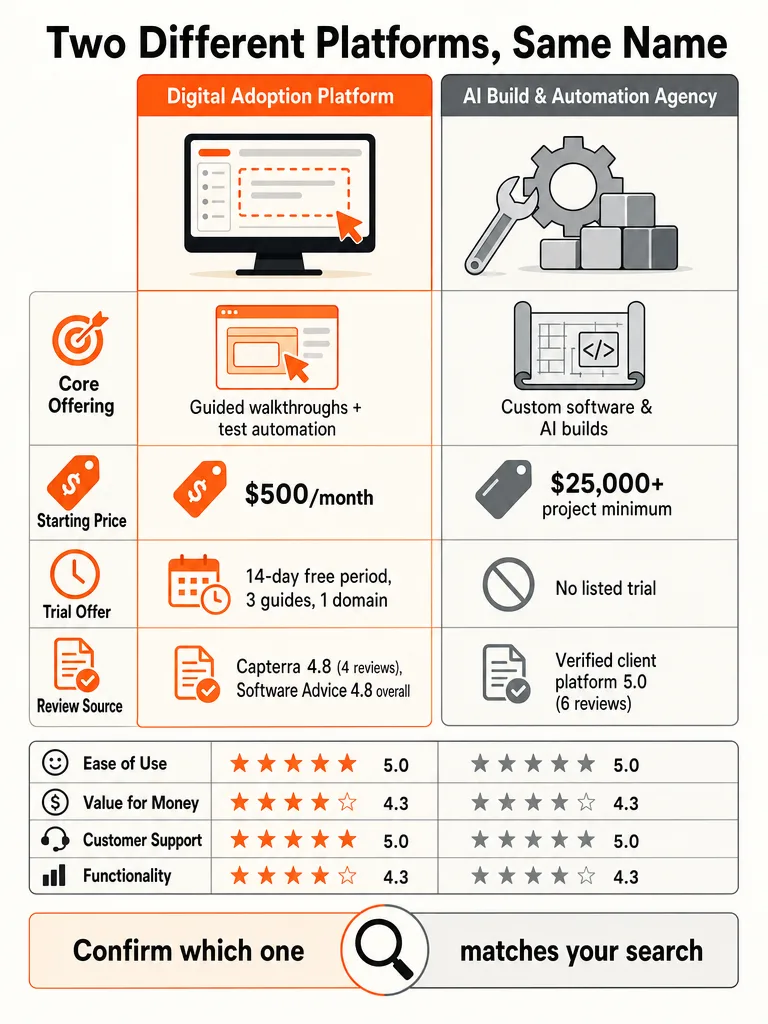
Ziplyne and ZipLyne sell almost nothing in common besides a similar name. One rents software that guides users through enterprise apps. The other gets hired to build the apps, automations, and AI systems a business runs on day to day.
The DAP vendor's own site describes its product as Digital Adoption and Test Automation combined in a single platform, with Ziplyne DAP and ZipRPA sharing workflows and change intelligence natively rather than through a bolted-on integration layer. Software Advice lists its starting price at $500 per month, and Capterra rates it 4.8 out of 5 based on 4 reviews as of its September 29, 2026 update. ZipLyne the agency appears on Clutch as a separate, verified profile for custom software and AI development. Public listings show two distinct domains and two distinct offerings, but the available sources don't confirm whether the businesses are formally connected in any way.
| Ziplyne (DAP vendor) | ZipLyne (AI build agency) | |
|---|---|---|
| Core offering | Digital adoption guides + ZipRPA test automation for apps like Salesforce, SAP, Workday, Microsoft Dynamics | Custom software, AI development, AI agents, AI consulting, UX/UI design |
| Pricing model | Starts at $500/month (Software Advice); ZEX tier listed at $1k/month on vendor pricing page | Minimum project $25,000+; most common project $10,000-$49,000 (Clutch) |
| Review platforms | Capterra (4.8, 4 reviews), Software Advice (4.8), G2 (10 reviews), Product Hunt | Clutch (5.0 average, 6 verified reviews) |
| Team size | Enterprise software vendor | 2-9 employees, founded 2022 |
Does Ziplyne Have a Free Trial, and What Do POV, ZCX, and ZEX Include?
Ziplyne offers a 14-day free period under what it calls a POV offer, according to the DAP vendor's own pricing page, which includes 3 guides, unlimited steps, and 1 application domain. That's enough to test the product on a single internal tool before paying for anything.
Beyond the free POV, the vendor's pricing page lists two paid tiers: ZCX, priced by monthly active users for SaaS customer-facing use cases, and ZEX, listed at $1,000 a month for enterprise employee-experience use cases. Software Advice's 2026 listing shows a different number entirely, a flat starting price of $500 a month with no plan breakdown beyond "Basic." The two figures don't reconcile cleanly; the marketplace listing and the vendor's own page describe pricing differently, so a buyer should confirm current numbers directly with Ziplyne before budgeting around either one.
What Features Does Ziplyne Include in 2026?
Ziplyne's confirmed feature set centers on contextual, in-app guidance rather than broad onboarding or deep analytics. Capterra lists contextual guidance, in-app training, interactive content, activity tracking, engagement tracking, audience targeting, customer segmentation, surveys and feedback, real-time notifications, and customizable branding as core capabilities. Software Advice's separate listing confirms audience targeting, content creation, contextual guidance, in-app training, launch management, self-service tools, user onboarding, and reporting and analytics.
Both marketplace listings agree on the same core: step-by-step in-app guides, targeting rules for who sees which guide, and basic usage analytics. Neither listing documents deeper capabilities like multi-product guide libraries, advanced segmentation logic, or integration depth, and the available sources don't cover technical details like browser support, security certifications, or deployment model.
The overlap between Capterra and Software Advice is the most reliable part of Ziplyne's public feature record: contextual guidance, in-app training, and audience targeting show up on both.
What Training and Support Does Ziplyne Offer?
Software Advice's 2026 profile says Ziplyne's support runs through chat and other online channels, with pricing details available on request rather than published upfront on that listing. The same profile scores Ziplyne's customer support at 5.0 out of 5, the highest of its four rating categories, alongside a 5.0 score for ease of use.
Public listings don't document a formal onboarding program, a dedicated implementation team, or a named training curriculum beyond the in-app training feature itself. That gap in published detail lines up with how the product appears to sell: through a demo-and-quote process rather than self-serve signup, which is also why Software Advice lists pricing as "available on request" even though the vendor's own pricing page publishes specific numbers for POV, ZCX, and ZEX.
What Does ZipLyne (the AI Agency) Actually Build?
ZipLyne's Clutch profile breaks its work into five service lines, and each one maps to a problem small businesses actually have instead of one a vendor invented to sell software. Custom software and AI development together make up 60% of the agency's work, with AI agents, AI consulting, and UX/UI design filling the rest.
- Custom software development (30%) replaces the spreadsheet or duct-taped tool a team outgrew. This is for owners buried in manual processes with no internal engineering team to fix it.
- AI development (30%) covers systems that actually do work, not chatbots that demo well and fail in production. ZipLyne's listed focus areas include chatbots and conversational AI, machine learning, and natural language processing.
- AI agents (15%) split across customer service, workflow, research, and sales use cases, aimed at businesses trying to scale output without adding headcount.
- AI consulting (15%) is strategy work for owners who can't tell real AI implementation from surface-level hype.
- UX/UI design (10%) rounds out the build my product service line for founders launching something new.
How Much Does It Cost to Hire ZipLyne?
Hiring ZipLyne starts at $25,000 for a project, per Clutch's listed minimum engagement size, with most completed projects landing between $10,000 and $49,000 based on Clutch's review data. That range covers a fixed-scope build: a defined app, tool, or automation shipped and handed over, with the client owning the code, accounts, and data, per ZipLyne's own Clutch profile description.
A fixed-scope project and an ongoing retainer are different buying decisions in software consulting generally, not just with this agency. A fixed build pays for one deliverable with a clear end date. A retainer pays for continuous work, which only makes sense once a first system is live and needs regular changes. Founders comparing these models against market rates should read the custom AI automation pricing breakdown for how build tiers and retainers typically split, and the AI app development cost guide for what founders building an app specifically tend to pay.
What Do Verified ZipLyne Reviews Say?
ZipLyne the agency holds a 5.0 average across 6 verified reviews on Clutch, with reviewers scoring it 4.9 for cost, 4.9 for schedule, 5.0 for quality, and 5.0 on willingness to refer. That's a clean sheet, but it's a small sample, and it belongs to a different business than the DAP vendor's review profile.
Ziplyne the DAP software sits at 4.8 on both Capterra and Software Advice, though both ratings come from small review pools. Capterra's score is based on just 4 reviews as of its September 29, 2026 update, and that same listing reports 92% of reviewers rated it above 4 stars. Software Advice's separate 2026 profile shows the same 4.8 overall score built from a different distribution: 75% of its reviews are 5-star and 25% are 4-star, with secondary scores of 5.0 for ease of use and 5.0 for customer support.
| Business | Platform | Rating | Review count |
|---|---|---|---|
| ZipLyne (agency) | Clutch | 5.0 | 6 verified reviews |
| Ziplyne (DAP) | Capterra | 4.8 | 4 reviews; 92% rated above 4 stars |
| Ziplyne (DAP) | Software Advice | 4.8 | 75% 5-star, 25% 4-star |
Neither side has enough volume to call the rating definitive. Treat both as directional, not conclusive, until the review counts grow.
Who Does ZipLyne Work Best For?
ZipLyne's Clutch profile shows 80% of its clients are small businesses under $10M in revenue, with the remaining 20% in the midmarket range between $10M and $1B. That split points to an agency built for operators who feel squeezed by manual work, not Fortune 500 procurement cycles.
By industry, business services and consumer products & services each account for 20% of ZipLyne's client base on Clutch, with legal, advertising & marketing, and insurance each making up another 10%. These are industries where scaling usually means adding headcount, hours, or tools, and where a custom build or automation often replaces all three.
Service businesses tend to fit this kind of work well in general: scheduling, intake, and booking are common places where off-the-shelf tools stop working once staff, deposits, or pricing rules get complicated. If that sounds familiar, see how a custom booking tool compares to Calendly once those rules pile up.
- Small business owner drowning in admin work with no technical hire on staff
- Founder with a product idea who needs an MVP built without hiring a team
- Operator trying to grow revenue without growing payroll
- Business in legal, insurance, or marketing services replacing manual workflows with automation
How to Start a Project With ZipLyne
Starting a project with ZipLyne follows a short path: a conversation about what's actually broken, a scoped proposal, and a build that ships.
- Describe the problem, not the solution. Bring the broken workflow, spreadsheet, or product idea. ZipLyne maps how the business actually runs before proposing a fix, per its own Clutch profile description.
- Get a scoped proposal. Based on Clutch's data, expect a minimum of $25,000+ for a project, with most landing between $10,000 and $49,000.
- Lock the build. Fixed-scope projects ship a defined deliverable; the client owns the code, the accounts, and the data when it's done.
- Decide if ongoing work makes sense. Many custom builds need some follow-up after launch: bug fixes, new features, or added automations as the business grows.
If the manual process, the missing app, or the admin pile is already costing you real money, the fastest fix is a conversation, not another month of research.
Frequently asked questions
Are Ziplyne and ZipLyne the same company?
No public record confirms any ownership link between them. Ziplyne the digital adoption platform and ZipLyne the AI build agency operate on separate domains, carry separate review profiles on different platforms, and sell different products: one guides users through enterprise software, the other builds custom apps and automation. Clutch lists the agency as founded in 2022 with offices in Miami, Tel Aviv, and Belgrade, a detail the DAP vendor's listings don't share. Treat them as distinct until proven otherwise.
What enterprise software does Ziplyne's digital adoption platform support?
Ziplyne's in-app guidance is built around Salesforce, SAP, Workday, and Microsoft Dynamics, according to Software Advice's 2026 listing of the product. The platform layers step-by-step guides and audience targeting on top of these systems rather than replacing them, so employees see contextual walkthroughs inside the tools they already use. Public listings don't document support for other enterprise suites beyond these four named systems.
Does Ziplyne have reviews beyond Capterra and Software Advice?
Yes, Ziplyne also shows a 4.7 rating on G2 and a 4.7 rating on Product Hunt, according to the vendor's own site. Those scores sit close to its 4.8 ratings on Capterra and Software Advice, giving a consistent picture across four platforms, though every pool remains small. No listing shows review volume large enough to treat any single score as definitive.
How many employees does ZipLyne the agency have, and where is it based?
ZipLyne runs with 2 to 9 employees out of three locations: Miami (headquarters), Tel Aviv, and Belgrade, according to its Clutch profile. The agency was founded in 2022 and operates across five timezones, supporting English and Hebrew. That small, distributed team structure lines up with how it sells engagements: fixed-scope projects starting at $25,000 rather than large staffed retainers.
What programming languages and frameworks does ZipLyne use to build custom software?
ZipLyne's Clutch profile lists TypeScript (35%), JavaScript (25%), Python (20%), SQL (10%), Kotlin (5%), and Swift (5%) as its core programming languages. On the framework side, Next.js, React Native, and Vue.js each account for 20% of its stack, with Node.js at 15%. That mix covers web apps, mobile apps, and backend APIs, matching the custom software and AI development work that makes up 60% of its service lines.
Is ZipLyne a good fit for a small business that wants AI automation?
Yes, 80% of ZipLyne's clients are small businesses under $10 million in revenue, per its Clutch profile, with the remaining 20% in the midmarket range between $10 million and $1 billion. The agency holds a 5.0 average across 6 verified Clutch reviews, with clients concentrated in business services, consumer products, legal, marketing, and insurance. That client mix points to a builder set up for operators replacing manual work, not enterprise procurement cycles.