


AI development agency vs freelancer: which ships faster after startup, QA, and fixes?
A freelancer usually ships faster on a narrow, well-scoped AI task, and an agency usually ships faster once a build needs project management, QA, DevOps, backfill, and post-launch fixes counted into the timeline. The split tracks project length. Inspired by Frustration puts the line plainly: freelancers win under 6 weeks, agencies win over 12 weeks.
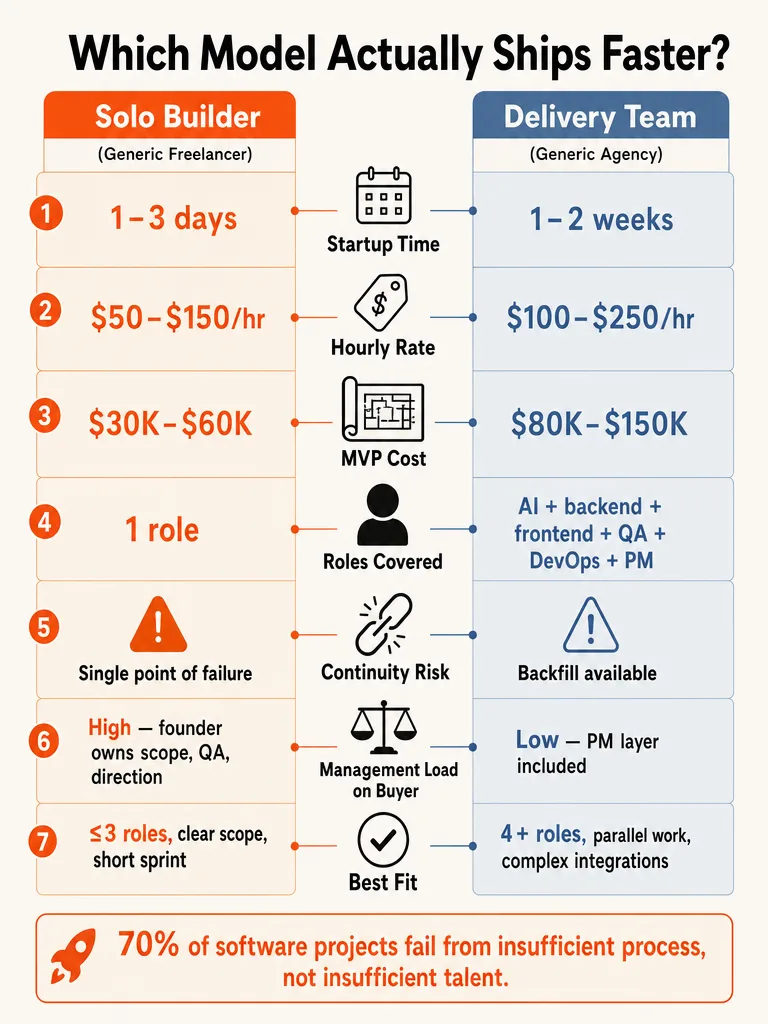
The first start date lies to you. A freelancer's onboarding runs 1 to 3 days versus 1 to 2 weeks for an agency, per RaftLabs. That head start is real, and it evaporates on anything complex.
Look at the full clock instead. Tilak Raj estimates a freelancer ships in 8 to 12 weeks and an agency in 6 to 16 weeks, in his 2026 build comparison. The ranges overlap because "faster" depends on how many things have to happen at once.
For most AI projects under $150k, one vetted senior ships faster than a mid-tier agency; the agency earns its premium only when a single person can't cover data, infra, front end, and PM at the same time.
The rest of this breaks the decision into cases you can actually match your project to.
Ready to move? Let's build something real.
When does a freelancer beat an agency for an AI project?
A freelancer beats an agency when the project is one clear use case, scoped to a short sprint, and you can manage product direction yourself. Inspired by Frustration's decision table names the exact fit: one clear use case, scoped, 4 to 8 weeks, pick a freelance senior because one brain owns the problem, no handoffs, no coordination tax.
The advantage is startup speed plus direct access. You message the person doing the work instead of a project manager. RaftLabs notes freelancers are faster and cheaper for single-deliverable tasks with clear inputs and outputs: a landing page, a Figma-to-code conversion, a model fine-tune, a short proof of concept.
Tilak Raj describes the tradeoff bluntly. A freelancer is the fastest model to start for a defined scope, but you supply the management, product direction, and continuity.
So the freelancer case holds when three things are true:
- The scope is narrow and you can write it down without hedging.
- The timeline is short, roughly 4 to 8 weeks.
- You have the time and technical judgment to review output and own what happens after.
Miss any one of those and the freelancer's speed starts leaking into your calendar.
When should you choose an agency when you're building an AI product?
Choose an agency when your build needs 4 or more roles working at once, or has more than 3 moving parts. RaftLabs sets the threshold: if your project has more than 3 moving parts, a backend, a frontend, a mobile app, third-party integrations, user auth, payments, you need a team that works together daily.
Agency speed comes from parallel work. While one person builds the API, another builds the frontend, a third handles QA. Inspired by Frustration's table makes the tradeoff explicit: when you need 4+ roles like data, ML, front end, PM, and design, subcontracting that yourself costs more in coordination than the agency's premium.
The delivery structure is the product, not the overhead. RaftLabs argues the PM, QA engineer, and DevOps person aren't padding. They're the reason the thing ships. The same source cites McKinsey research that 70% of failed software projects fail on insufficient process, not insufficient talent.
An agency also kills single-person failure risk. RaftLabs rates freelancer availability risk as high, one person gets sick and the project stops, versus low for agencies because they backfill. On a multi-month build, that continuity is a speed factor, not a comfort factor.
Freelance AI developer vs agency: cost, speed, risk compared
Freelancers cost less per hour and start faster; agencies cost more but carry QA, backup coverage, and structured delivery. RaftLabs lists effective rates of $100 to $250/hr for an agency versus $50 to $150/hr for a freelancer. The rate gap flips once you count what the freelancer's price leaves out.
| Factor | Freelancer | Agency |
|---|---|---|
| Effective hourly rate | $50 to $150 | $100 to $250 |
| MVP timeline | 8 to 12 weeks | 6 to 16 weeks |
| Onboarding | 1 to 3 days | 1 to 2 weeks |
| Typical project cost | $30K to $60K | $80K to $150K |
| QA | Developer self-tests, you verify | Dedicated QA, code review, CI/CD |
| Availability risk | High, one person | Low, team backfills |
| Management | You own scope and deadlines | PM owns timeline |
Rate ranges from RaftLabs; timeline and project-cost bands from Tilak Raj.
The clearest cost math comes from Inspired by Frustration. A freelance senior at 200 hours times $200 runs $40k. The same project at an agency, 400 hours times $220 blended, runs $88k, because the agency's blended rate averages a PM, designer, junior, senior, and specialist, and only about 40% of those hours are the senior actually building. The agency charges roughly 2x when the work fits inside one senior's scope.
What 'ships faster' actually means across scope, build, QA, and launch
"Ships faster" means the total time to a working product in production, not the first start date. Most comparisons measure kickoff and stop there. The real clock includes scoping, discovery, build, integrations, QA, deployment, post-launch fixes, and handoff. A freelancer who starts in 1 to 3 days can still finish slower than an agency once those later stages stack up.
Break the timeline into its real stages:
- Scoping and discovery, defining the outcome and the edges.
- Build, the part people wrongly treat as the whole project.
- Integrations, payments, auth, third-party APIs, the AI layer.
- QA, testing under real conditions, not a happy-path demo.
- Deployment, getting it live and stable.
- Post-launch fixes, the bugs that only appear in production.
- Handoff, documentation and knowledge transfer so you own it.
RaftLabs warns that freelancers optimize for speed over maintainability, skipping tests, documentation, and infrastructure that agencies build from day one. That skip shows up as time later. Comparing start dates picks the fast starter; comparing the full pipeline picks the model that gets you a working product, which is the only date that pays. For a deeper look at what production actually demands, see what real AI app development looks like in production.
How much founder management does a freelancer really require?
A freelancer moves fast on the build, but you own scope, deadlines, quality control, technical review, coordination, and continuity. Tilak Raj is direct: with a freelancer, you provide the management, the product direction, and the continuity. RaftLabs frames the same tax as scope, deadlines, and communication landing on you.
That's the hidden line item nobody quotes. The freelancer's lower sticker price assumes your time is free. RaftLabs makes the point that the lower price disappears once you account for your own management hours, and that starting with a freelancer on a complex project often means paying twice, once for the build and once to fix it.
Continuity is where the cost compounds. The LinkedIn analysis of hiring models cites that projects with rotating freelance talent see 30 to 40% higher rework costs from knowledge loss. If your single freelancer disappears, that knowledge walks out with them.
Run the honest math before you sign. A $50/hr freelancer whose work you can't judge costs more than a $200/hr senior you can hand a spec and walk away from.
Where agency process helps and where it slows the build
Agency process speeds complex builds and slows simple ones. The same PM layer, onboarding, and handoff structure that keeps a multi-role program on track becomes friction on a two-week, single-deliverable task. RaftLabs puts agency onboarding at 1 to 2 weeks for discovery and team setup, versus 1 to 3 days for a freelancer on a focused task.
Where process earns its keep: the LinkedIn hiring analysis reports agencies move startups from MVP to production 30 to 50% faster using reusable frameworks and cross-industry experience. On a build with backend, frontend, integrations, and QA running in parallel, that structure compresses the timeline instead of stretching it.
Where it drags: short, well-scoped work. If the whole job is a Shopify plugin or a single model fine-tune, the weekly demos, sprint planning, and handoffs between team members add days without adding output. You're paying the process tax on a project that never needed the process.
The tell is the minimum. Inspired by Frustration notes agencies carry $50k minimums that don't bend. If your project is genuinely under $30k, an agency will either turn it down or pad it up to the floor. Neither ships your small thing faster.
What is the hybrid model that beats both freelancer and agency?
The hybrid is a senior builder or fractional founder-builder who owns scope and shipping, then pulls in specialists only when the work demands it. Tilak Raj calls it the fourth option most comparison posts ignore: a fractional founder-builder who scopes and ships your first version, then hands it off. He describes it as agency-level judgment without agency-level overhead or lock-in.
It closes both weak spots. You get one accountable person, so no coordination tax and no PM layer slowing a tight build. You also get continuity and range that a lone freelancer can't guarantee, because the builder brings in a designer or an infra specialist for the exact window they're needed instead of stopping the project cold.
Inspired by Frustration backs the model too, calling out the hybrid that beats both on projects that don't fit the clean freelancer-or-agency binary.
This is where ZipLyne sits. Isaac Horowitz operates as one senior builder owning strategy, build, and launch, pulling specialists in only where a project needs them, which is the fit when you want speed without agency bloat or single-freelancer fragility.
The hybrid wins when your build is too complex for one freelancer to own alone but too small to justify a full agency and its floor.
What contract and handoff terms keep you from getting trapped later?
Get code ownership, documentation, and knowledge transfer written into the contract before work starts, so you can maintain the product when the engagement ends. The trap the sources flag is continuity: Tilak Raj warns of founders stuck in agency contracts where they learned nothing and could not maintain their own product, and the LinkedIn analysis ties rotating talent to 30 to 40% higher rework from knowledge loss.
The freelancer version of the same trap is skipped groundwork. RaftLabs notes freelancers often skip tests, documentation, and infrastructure, which leaves you with a black box the day they move on.
Insist on these before you sign:
- Code ownership, full IP assignment to you, in writing.
- Documentation, how the system works, not just working code.
- Milestones, defined deliverables tied to payment, so progress is verifiable.
- QA expectations, what gets tested and how, spelled out.
- Knowledge transfer, a handoff so your team or your next builder can run it.
- Post-launch support, a defined window for the bugs that surface in production.
Independent detail on escrow, termination, and warranty terms is limited in the sources here, so treat those as points to negotiate directly rather than assume as standard.
Where to go deeper on AI MVP cost and production-ready builds
Once you've picked a model, the next questions are cost and scope. These ZipLyne breakdowns go deeper than a comparison table can.
- Budget first: AI app development cost: what founders actually pay and the real cost of building an MVP in 2026.
- Scope right: AI-native MVP development: what founders actually need and how to scope an AI SaaS MVP without wasting 6 months.
- Ship faster: rapid MVP development: how to ship in weeks, not months and why your MVP is taking too long.
- Build for production: what real AI app development looks like in production and AI prototype vs MVP: what founders should build first.
How to choose between a freelancer, an in-house team, or AI development agency?
Match the model to the shape of the work, not the sticker price. Freelancer for a narrow task, agency for a multi-role production build, in-house only when AI is your core long-term product, and hybrid when one accountable builder can ship faster with selective specialist support. Tilak Raj prices the extremes: freelancer at $30K to $60K, agency MVP at $80K to $150K, in-house at $700K+ in year one.
Run down the checklist:
- Freelancer, one clear use case, 4 to 8 weeks, you can manage direction and review output yourself.
- Agency, 4+ roles at once, more than 3 moving parts, regulated compliance, or a multi-quarter program needing continuity past any one person.
- In-house, AI is your differentiator and you need permanent institutional knowledge, per Tilak Raj.
- Hybrid, too complex for one freelancer, too small for an agency floor, and you want one accountable builder pulling specialists in as needed.
The wrong choice costs more than a wrong tech stack, because it locks in your speed, your budget, and how dependent you stay on someone else. Decide by the work in front of you, then start.
Know which model fits your build? Let's build something real.
Frequently asked questions
For AI projects under $150k, does a freelancer or agency ship faster?
For 80% of AI projects under $150k, a vetted freelance senior ships faster and cheaper than a mid-tier agency. The advantage holds only when the scope is narrow, the timeline is 4–8 weeks, and you can manage product direction yourself. Once the build needs 4+ roles running in parallel, the agency's parallel execution closes that gap — then passes it.
What does an AI development agency actually cost vs a freelancer in 2026?
Agency blended rates run $100–$250/hr; freelancers run $50–$150/hr. In real project math: a freelance senior at 200 hours × $200 costs $40k. The same scope through an agency — 400 hours at a $220 blended rate — runs $88k, because roughly 40% of agency hours are the senior actually building. Freelancer project costs land at $30k–$60k; agency MVPs at $80k–$150k.
When should a startup choose an agency over a freelancer for an AI build?
Choose an agency when the project has more than 3 moving parts — backend, frontend, integrations, auth, payments — or requires 4+ roles working simultaneously. A McKinsey-cited stat in the source material puts 70% of failed software projects down to insufficient process, not insufficient talent. The PM, QA engineer, and DevOps person aren't overhead; they're why it ships.
How much founder time does managing a freelance AI developer actually require?
More than the hourly rate implies. With a freelancer, you own scope definition, deadline management, quality review, technical coordination, and continuity. Projects with rotating freelance talent run 30–40% higher rework costs from knowledge loss. A $50/hr freelancer whose output you can't evaluate independently often costs more than a $200/hr senior you can hand a spec and walk away from.
What is a fractional founder-builder and how does it compare to a freelancer or agency?
A fractional founder-builder is a senior operator who scopes, builds, and ships your first version, then transfers the code and knowledge to you — agency-level judgment without agency-level overhead or lock-in. It closes both weak spots: no coordination tax from a PM layer, and no single-freelancer fragility. It's the right fit when your build is too complex for one freelancer but too small to hit an agency's $50k minimum.
What contract terms should you lock in before hiring an AI developer or agency?
Get full IP assignment, system documentation, defined QA expectations, milestone-tied payments, and a post-launch support window written into the contract before work starts. Tilak Raj cites founders trapped in agency engagements where they couldn't maintain their own product. Freelancers often skip tests and documentation entirely — that omission becomes your problem the day they move on.
Sources
- Software Agency vs Freelancer: How to Choose in 2026www.raftlabs.com
- Freelancer Vs Agency Ai Developmentspeedmvps.com
- AI Agency vs Freelancer vs In-House: How to Choose in 2026www.tilakraj.info
- Freelance AI Developer vs Agency: Cost, Speed, Risk ...inspiredbyfrustration.com
- How to Choose Between a Freelancer, an In-House Team, ...www.linkedin.com
- App Development Agency vs Freelancer vs In-House Teamwww.bolderapps.com
- AI Development Company vs Freelancers: Which to Choose?www.f22labs.com