


How much does AI automation cost in 2026?
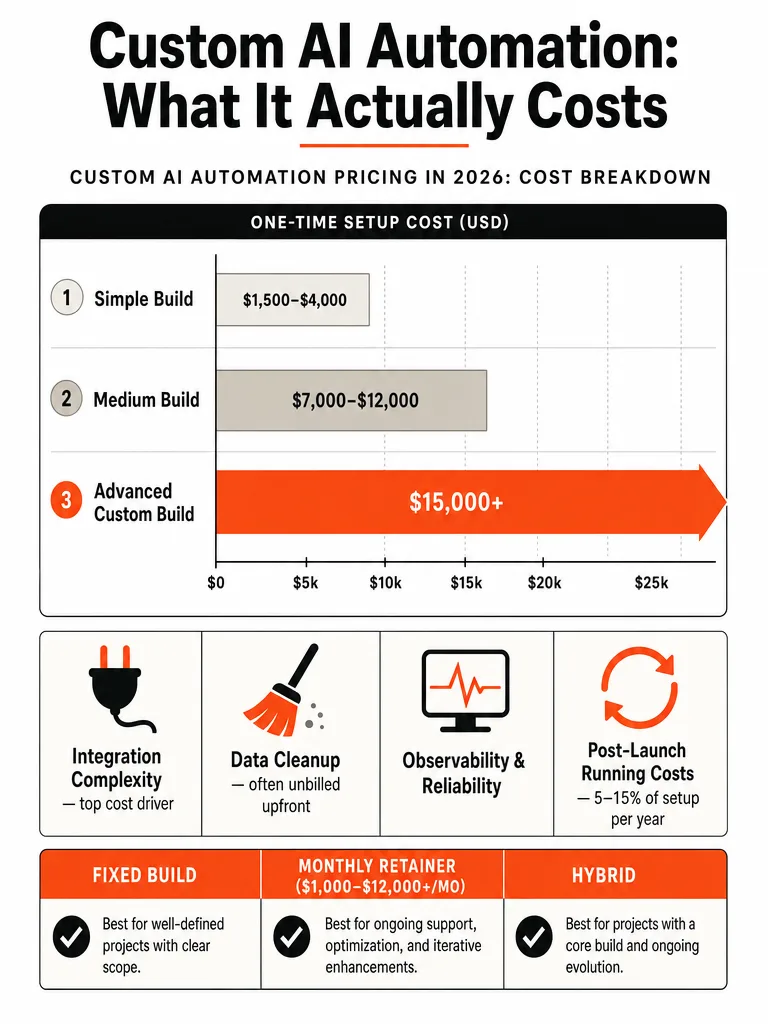
Most AI automation projects cost between $1,500 and $25,000 as a one-time setup in 2026, according to Parix's 2026 pricing guide. Simple builds land at $1,500–$4,000, medium builds at $7,000–$12,000, and advanced custom AI starts at $15,000 and climbs. Running costs add roughly 5–15% of setup per year.
That's the number. Now the nuance that most guides skip.
The setup cost is the wrong figure to fixate on. Parix says well-scoped projects pay for themselves in two to six months, so the payback window matters more than the sticker price. After that, it's just monthly cost for as long as the system runs.
If you're buying from an agency rather than pricing a DIY build, the bands shift slightly. Taskip puts agency engagements at $1,500–$12,000 for a one-off build or $1,000–$12,000+ per month for a retainer. Digital Agency Network puts typical automation builds at $2,500–$15,000+, with ongoing monitoring retainers from $500 to $5,000+.
The spread is wide because "automation" covers everything from moving form submissions into a CRM to an AI system that reads your inbox and triages leads overnight. The rest of this guide breaks the price into tiers you can actually place your project in, then shows the hidden multipliers vendors bury in the quote.
How much should you budget for a custom AI automation build?
A custom AI automation build in 2026 ranges from $500 for a basic workflow to $150,000+ for an enterprise platform, and where you land depends almost entirely on reasoning depth and integration count. The 5090 Reports, which surveyed 40+ real agent builds from actual invoices, gives the cleanest ladder available.
Place your project against these tiers:
| Tier | Build cost | Monthly run cost | Timeline | Best for |
|---|---|---|---|---|
| DIY / No-code | $0–$500 | $10–$50 | 1–3 days | Solo founders, internal tools |
| Workflow automation | $500–$2,500 | $20–$100 | 3–7 days | SMBs automating repetitive tasks |
| Custom single agent | $2,500–$8,000 | $50–$300 | 1–3 weeks | Product teams, customer-facing bots |
| Multi-agent system | $8,000–$25,000 | $200–$1,000 | 3–6 weeks | Coordinated AI workflows |
| Enterprise platform | $25,000–$150,000+ | $1,000–$10,000 | 2–6 months | Fortune 500, regulated industries |
Numbers from The 5090 Reports.
Two other sources sanity-check the middle of this range. Kellton says small businesses can start with a scoped, single-use-case build for $5,000–$50,000, delivered in two to six weeks. AbedinTech puts a single-workflow AI agent at $3,000–$20,000 and a production agent with retrieval and integrations at $15,000–$75,000.
Pick the smallest tier that solves your actual problem, not the flashiest one a vendor can sell. Most SMBs need workflow automation or a single agent, not a multi-agent system.
Want a build scoped to the smallest tier that solves your problem? Let's build something real.
What is a typical monthly retainer for AI automation services?
A monthly AI automation retainer in 2026 usually falls into three tiers: light support at $1,000–$3,500/month, full-service multi-workflow support at $4,000–$12,000/month, and productized packages at $500–$4,000/month, per Taskip. The retainer pays for ongoing optimization, monitoring, and net-new workflow work after the initial build ships.
Here's what each buys you:
- Light support ($1,000–$3,500/month): maintenance, bug fixes, minor tweaks, and keeping existing automations running. No large new builds.
- Full-service ($4,000–$12,000/month): active development of new workflows on top of maintenance, reporting, and a named contact who owns the account.
- Productized package ($500–$4,000/month): a fixed scope of automations sold as a repeatable offer, with defined limits.
Digital Agency Network lands in the same zone, listing ongoing monitoring retainers at $500–$5,000+. AbedinTech puts managed workflow automation at $500–$2,500/month.
The trap: paying a full-service retainer when you only need light support. If the build is done and stable, you don't need $8,000/month of "optimization." You need someone on call. Match the retainer to the actual work, and demand a line item showing how much goes to maintenance versus new development.
Fixed build vs monthly retainer vs hybrid: which pricing model fits the work?
Three pricing structures dominate AI automation work: project-based, monthly retainer, and productized package, and Taskip says each shifts risk differently. A fixed build fits a defined, one-time job. A retainer fits ongoing change. A hybrid (fixed build plus light support) fits most SMBs better than either extreme.
| Model | Best when | Watch for |
|---|---|---|
| Fixed build | Scope is clear, the job is one-time, you have internal capacity to maintain it | Change requests billed separately; no post-launch coverage |
| Monthly retainer | Workflows evolve monthly, you need continuous new builds and monitoring | Paying full-service rates for what's really maintenance |
| Productized package | You want a known, repeatable scope at a fixed monthly price | Rigid limits; overages that add up fast |
| Hybrid | You want a build now plus a small support line after launch | Confirm what "support" actually includes |
Structures per Taskip.
Digital Agency Network notes hourly billing is fading across AI services in favor of output-, usage-, and performance-based models. That's good for buyers: you pay for shipped outcomes, not clocked time.
A retainer is justified when the work genuinely keeps coming: new integrations, new workflows, changing rules every month. If your automation is stable and you're mostly paying for uptime, a fixed build plus a light support line is the cheaper structure. Don't let a vendor sell you recurring revenue you don't need.
What affects AI automation agency pricing?
Integration complexity, not workflow length, is the single biggest driver of AI automation pricing, according to Taskip. A ten-step workflow with one clean API is cheaper than a three-step workflow stitched across four legacy systems. The same source says integrations without clean APIs often add 20–40% to overall cost.
The real cost multipliers, ranked by how hard they hit the quote:
- Reasoning depth. The 5090 Reports says the gap between a routing agent and a reasoning agent is 5–10x. A $500 agent classifies a payload and forwards it to Slack. An $8,000 agent reads a support ticket, understands the actual problem, searches a knowledge base, drafts a calibrated reply, and escalates when confidence drops below 80%.
- Number of integrations. The 5090 Reports prices each tier: 3–5 integrations add $1,000–$2,000, and 6–10 add $2,000–$5,000. The hidden cost isn't the connection, it's handling auth token refresh, rate limits, schema changes, and partial failures.
- Data readiness. SotaTek says 60–80% of an AI project's time and budget often goes to data preparation. Kellton puts data prep at 40–60% of custom AI timelines.
- Legacy systems. Old software without modern APIs forces custom connectors, which is where that 20–40% clean-API penalty lands.
Dirty data and missing APIs cost more than complex logic ever will. If a vendor quotes you without asking about your data or your systems, the number is a guess.
What ongoing costs should you expect after an AI automation build launches?
The API and infrastructure spend that follows launch, not the build cost, is what catches teams off guard, warns The 5090 Reports. Monthly run costs range from $10–$50 for a no-code tool to $1,000–$10,000 for an enterprise platform. Parix frames the annual number as roughly 5–15% of your setup cost.
The recurring line items:
- Model and token costs. Digital Agency Network cites GPT-4 Turbo at $0.003–$0.012 per 1,000 tokens depending on tier. High-volume workflows compound this fast. The same source notes agencies increasingly separate platform costs from execution because pricing includes token usage, API consumption, infrastructure, and human labor.
- API consumption. Every third-party call has its own metered cost.
- Hosting and infrastructure. Cloud compute on AWS, Azure, or GCP scales with usage.
- Monitoring and maintenance. Someone has to watch it, patch it, and fix it when an upstream API changes.
Why production-ready automation costs more than a demo
Production reliability is the most underestimated cost multiplier in AI automation, and The 5090 Reports puts hard numbers on the jump from "works on my machine" to "holds up in production." Each layer of reliability stacks onto the base quote.
| Reliability layer | Cost added |
|---|---|
| Basic error handling | Baseline |
| Structured logging + alerts | +15–20% |
| Automatic retries + circuit breakers | +20–30% |
| Human-in-the-loop escalation | +25–40% |
| Compliance audit trail | +30–50% |
| SLA-backed uptime guarantee | +50–100% |
Figures from The 5090 Reports.
A demo looks identical to a production system right up until an API times out, a token expires, or the model returns garbage. The demo breaks silently. The production build retries, logs the failure, alerts a human, and keeps the rest of the workflow moving.
That's the gap you're paying for. Observability tells you when something's wrong. Retries and circuit breakers stop one bad call from cascading. Human-in-the-loop escalation catches the low-confidence decisions before they touch a customer. Audit trails prove what happened when a regulator or client asks.
If a quote for a customer-facing or money-touching automation looks suspiciously cheap, it's almost certainly missing the reliability layer. For more on what separates a demo from a shipped system, see what real AI app development looks like in production.
Workflow automation vs custom AI agent: what should you build first?
Most businesses should build workflow automation before a custom AI agent, because a workflow is cheaper, faster, and enough for rules-based tasks. The 5090 Reports prices workflow automation at $500–$2,500 to build versus $2,500–$8,000 for a custom single agent, delivered in days rather than weeks.
The dividing line is simple. If the task follows fixed rules, "when this form comes in, create this CRM record," you want a workflow. If the task requires judgment, "read this ticket and decide what the customer actually needs," you want an agent. A multi-agent system ($8,000–$25,000) only earns its cost when several AI components have to coordinate.
Start with the workflow leaking the most time, prove the win, then layer intelligence where the work genuinely varies. Most SMBs get 80% of the value from plain automation.
To go deeper on the decision and the build path, these guides help:
How can you tell whether a $4,000–$12,000/month retainer is fair?
A $4,000–$12,000/month retainer is fair when the proposal itemizes exactly what recurs, and it's padded when it doesn't. Taskip puts full-service retainers in this exact band and gives buyers a checklist: confirm itemized scope, a named post-launch support period, a named account contact, and a 30-day exit clause before signing.
Run the proposal through these questions:
- Is the scope line-itemed? You should see hours or deliverables split between maintenance and net-new workflow development. A single lump sum is a red flag Taskip calls out directly.
- Who owns the accounts? The API keys, cloud accounts, and integrations should be in your name, not the agency's. Locked tooling traps you.
- What does reporting look like? Opaque reporting means you can't verify you're getting the retainer's worth.
- What's the overage policy? Know the rate before you blow past the included scope, not after.
- Is there a 30-day exit clause? No exit means the agency has no pressure to keep delivering.
Taskip also flags urgency pressure on pricing as a red flag. A fair retainer doesn't need a countdown timer.
A retainer with no line-item breakdown, locked tooling, and no exit clause is padded scope wearing a suit. For context on when building custom beats renting a platform, compare custom CRM vs HubSpot.
What to compare before you sign an AI automation proposal
Before signing any AI automation proposal, compare seven things: build cost, monthly support, separate software and API spend, maintenance responsibility, ownership terms, ROI window, and whether hiring in-house would cost more. Taskip notes an agency at $5,000/month is often cheaper than one in-house hire once you count benefits, management overhead, and redundancy.
Your pre-signature checklist:
- Build cost: placed in the right tier for your project's reasoning depth and integration count.
- Monthly support: split between maintenance and new development, not a lump sum.
- Software and API spend: billed separately and projected, so token costs don't surprise you.
- Maintenance responsibility: clearly assigned to the agency or to you.
- Ownership: accounts, keys, and code in your name.
- ROI window: Parix says a well-scoped project pays back in two to six months. If the math doesn't get there, rescope.
- In-house comparison: Kellton puts AI specialist salaries at $120,000–$300,000+ annually. One hire often costs more than a full build plus a year of support.
Score the proposal against every line before the pen touches paper.
Ready to scope a build against numbers you can defend? Let's build something real.
Frequently asked questions
How much does AI automation cost in 2026?
Most AI automation projects cost $1,500–$25,000 as a one-time setup in 2026. Simple builds land at $1,500–$4,000, medium builds at $7,000–$12,000, and advanced custom AI starts at $15,000 and climbs. Annual running costs add roughly 5–15% of that setup figure. Well-scoped projects typically pay for themselves within two to six months — so the payback window matters more than the sticker price.
What is a typical monthly retainer for AI automation services?
Monthly AI automation retainers fall into three bands: light support at $1,000–$3,500/month, full-service multi-workflow support at $4,000–$12,000/month, and productized packages at $500–$4,000/month. Light support covers maintenance and bug fixes. Full-service adds active new workflow development and a named account contact. The trap is paying full-service rates when your build is stable and you only need someone on call.
What is the biggest cost driver in AI automation pricing?
Integration complexity drives price more than workflow length. A three-step workflow stitched across four legacy systems costs more than a ten-step workflow with one clean API — messy integrations add 20–40% to overall cost. Reasoning depth compounds this: the gap between a simple routing agent and a full reasoning agent is 5–10x, with data preparation consuming 60–80% of project time and budget on many builds.
What ongoing costs should you expect after an AI automation build launches?
After launch, expect model and token costs (GPT-4 Turbo runs $0.003–$0.012 per 1,000 tokens), API consumption fees for every third-party call, cloud hosting on AWS, Azure, or GCP, and monitoring and maintenance labor. Monthly run costs range from $10–$50 for no-code tools to $1,000–$10,000 for enterprise platforms. A cheap build paired with an expensive model choice can cost more annually than a pricier build running lean prompts.
Should you build workflow automation or a custom AI agent first?
Start with workflow automation — it costs $500–$2,500 to build versus $2,500–$8,000 for a custom single agent, and delivers in days rather than weeks. The dividing line: fixed rules like 'when this form arrives, create a CRM record' call for a workflow; judgment calls like 'read this ticket and decide what the customer actually needs' call for an agent. Most SMBs get 80% of the value from plain automation before adding any intelligence layer.
Why does production-ready AI automation cost more than a demo?
Production reliability stacks costs onto the base quote in measurable layers: structured logging and alerts add 15–20%, automatic retries and circuit breakers add 20–30%, human-in-the-loop escalation adds 25–40%, and an SLA-backed uptime guarantee adds 50–100%. A demo breaks silently when an API times out; a production build retries, logs the failure, alerts a human, and keeps the workflow moving. Customer-facing or money-touching automations that look suspiciously cheap are almost certainly missing this layer.
Sources
- AI Automation Cost Breakdown for Businesses in 2026www.sotatek.com
- AI Agency Pricing Guide 2026: Models, Costs & ...digitalagencynetwork.com
- Enterprise Custom AI Development Cost in 2026www.kellton.com
- How Much Does AI Automation Cost in 2026? Real Pricesabedintech.com
- AI Automation Cost 2026: Transparent Build Rangespeppereffect.com