


What an AI operations audit actually inspects
An AI operations audit inspects the work itself: your operational workflows, the handoffs between them, the tools running them, and the bottlenecks bleeding hours and money. It's a workflow-focused diagnostic that finds where applied AI fits, what it would replace, and how much it would save. According to Navicade, it's a 7-day diagnostic that ranks every manual, repeatable, costly workflow inside a business by what AI can genuinely change.
So the inspection objects are concrete, not abstract:
- Workflows running the business day to day, usually 3–5 critical ones mapped in detail
- Handoffs where work passes between people, teams, or systems and slows down
- Systems and tool stack, checked for redundant, underused, or missing pieces
- Bottlenecks marked directly on the workflow maps
- Quantified waste, measured in hours per month and cost
- Buildable opportunities, scored and ranked for what to fix first
That last part matters. Mindflows frames its version as a fixed-scope diagnostic that ends in a prioritized 12-month roadmap with build cost estimates, not a score. The point isn't to tell you how "AI-ready" you are. It's to hand you a list of specific things worth building, in order.
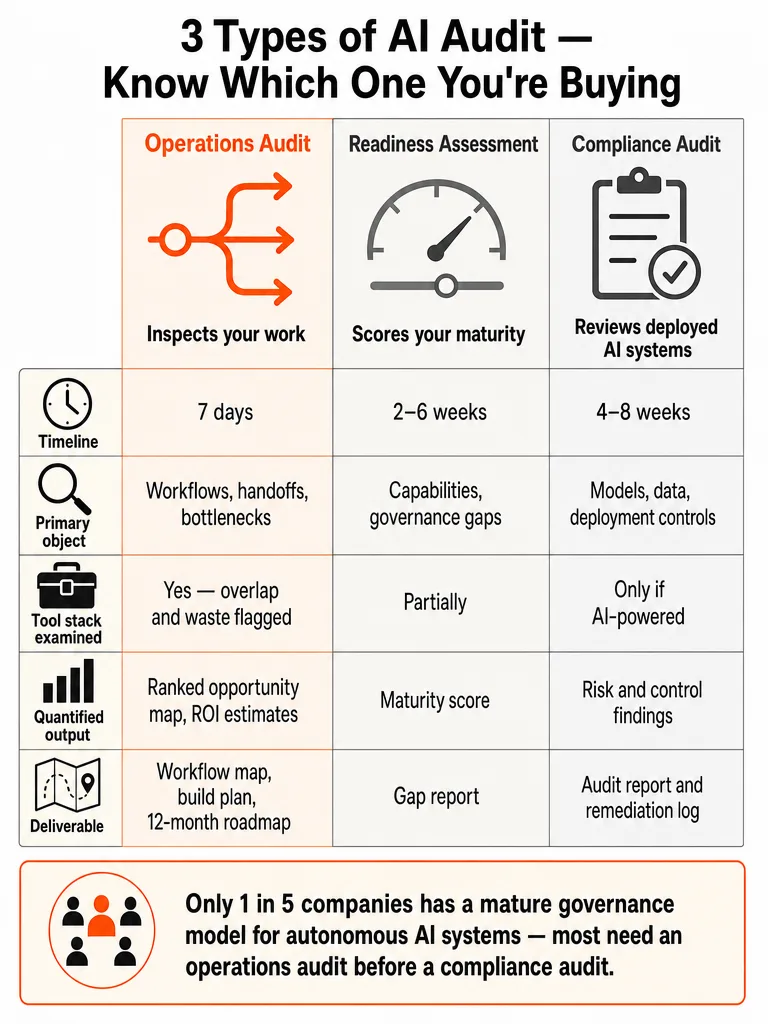
How an AI Operations Audit differs from an AI readiness assessment
Three different diagnostics get sold under "AI audit," and buying the wrong one wastes money. An operations audit looks outward at the work. A readiness assessment looks inward at the organization. A compliance audit looks backward at AI you already deployed. Navicade draws exactly this line: operations audits examine workflows to find where AI applies, readiness assessments score general AI maturity across infrastructure, data, governance, and people, and compliance audits evaluate deployed systems against regulatory frameworks.
The confusion is real. Navicade points out that most pages ranking for "AI audit" answer one of the other two questions. IBM, PwC, and EY write about compliance and governance audits: bias, security, and regulatory exposure under the EU Artificial Intelligence Act, which entered into force in August 2024 and reaches full applicability in August 2026. Consultancies write about readiness using five-pillar maturity models. The NIST AI Risk Management Framework and its GOVERN, MAP, MEASURE, MANAGE cycle is the most cited US anchor for both.
Timelines separate them too.
| Diagnostic | What it inspects | Typical duration |
|---|---|---|
| AI operations audit | Existing workflows and where AI fits | 7 days (Navicade) |
| AI readiness assessment | General AI maturity of the organization | 2–6 weeks |
| Compliance AI audit | Already-deployed AI systems vs. regulation | 4–8 weeks |
Source: Navicade's comparison of the three.
If your question is "where should we apply AI and what will it save," you want an operations audit, not a maturity score. The other two are legitimate, but neither answers what an operator asks before spending money on a build.
Which workflows, handoffs, and bottlenecks get examined first?
The audit starts with 3–5 critical workflows, not a full org-wide sweep. Mindflows scopes its analysis phase around process mapping for 3–5 critical workflows, then a tool stack assessment flagging what's redundant, underused, or missing. The selection is driven by where stakeholders say the pain is and where the numbers confirm it.
The first inspection targets tend to be the same across operators buried in manual work:
- Workflows leaking hours or money. Mindflows quantifies pain points directly in hours per month and euro cost, so a process eating a full-time equivalent's worth of admin surfaces fast.
- Bottleneck markers. Mindflows adds these straight onto its workflow maps, so you see where work stalls, not just that it does.
- Handoffs between disconnected tools. The audience Mindflows names is explicit about this: "multiple tools that don't talk to each other." Handoffs where data gets re-keyed by hand are prime targets.
- Redundant or underused tools. The stack assessment separates what you're paying for from what you actually use.
Navicade frames the same starting point differently: every manual, repeatable, costly workflow inside the business, ranked by what AI can change. Repeatable and costly are the two filters. A one-off task nobody repeats isn't worth automating. A repeated one bleeding hours every week is exactly what gets examined first.
What evidence and inputs will the auditor need from my team?
Expect to hand over context, access, and honest numbers, not polished reports. Mindflows structures its discovery phase around a kickoff call of 60–90 minutes, 2–3 stakeholder interviews at 45 minutes each, a systems inventory, a document review, and a pre-work questionnaire. That's the raw material a good audit runs on.
The inputs the corpus supports:
- Kickoff context on what the business does and where leadership thinks it's stuck
- Stakeholder interviews, 2–3 people who actually run the systems, per Mindflows
- Systems inventory and document review covering your current tool stack
- Workflow details for the 3–5 processes getting mapped
- Time and cost pain points, so waste can be quantified
Where the work is physical or inspection-heavy, the evidence set widens. Mitti, by SafetyCulture, notes that AI-driven inspections analyze safety data including photos, videos, sensor readings, and historical incident reports to catch patterns that manual review misses. If your operation runs on field data rather than spreadsheets, expect that material to be part of the audit too.
The clearer your inputs, the sharper the output. Vague answers about "where time goes" produce a vague map. Real numbers produce a ranked build plan.
How does an AI operations audit quantify waste and rank opportunities?
Findings become a ranked opportunity map scored on three axes: financial impact, technical feasibility, and risk. Navicade scores every opportunity on savings or revenue recovered, whether it can be built with current AI capability, and regulatory, operational, or reputational risk. The top of the map is the highest-impact, lowest-risk, most-feasible workflow, so you build in the right order instead of chasing the shiniest idea.
Mindflows runs the same logic through an impact-versus-effort matrix, pairing each scored opportunity with quantified pain points in hours per month and euro cost. That's the step that separates an operations audit from AI hype. Every recommendation carries a number attached to a real process, not a generic claim that AI saves time.
Mindflows backs this with a hard commitment: it will refund the full fee if the audit doesn't surface at least 5 quantified opportunities the client wasn't already actively planning. That's a vendor putting price on the promise that the inspection produces net-new, buildable findings.
The scoring shape looks like this:
| Scoring axis | Question it answers | Source |
|---|---|---|
| Financial impact | How much does this save or recover? | Navicade |
| Technical feasibility | Can it be built with today's AI? | Navicade |
| Risk | What regulatory or operational exposure? | Navicade |
| Impact × effort | Is the payoff worth the build cost? | Mindflows |
The ranking is the whole product: a scored list telling you which manual workflow to automate first, with the savings and the build cost both attached.
What does the audit report hand you after inspection?
You walk away with working documents, not slides. Navicade names three deliverables from every audit: a Revenue Leak Map that ledgers where manual work costs measurable money, an AI Opportunity Map that ranks which workflows AI can change first with expected savings and risk, and a Build Plan written as an implementation spec any qualified engineering team can execute. Navicade is blunt that these are documents the business uses for the next 90 days, not a presentation deck.
Mindflows delivers a comparable package with more structure around it:
- A 12–18 page audit report, every recommendation carrying a specific action, owner, timeline, and cost estimate
- A prioritized 12-month roadmap with build cost estimates
- Build cost estimates for the top 3 recommended projects
- A 90-minute roadmap presentation with stakeholders
- A 30-minute follow-up Q&A within 14 days of delivery
The report structure Mindflows publishes runs an executive summary (top 3 findings, recommended first move, expected ROI in one page), a current-state assessment (tool stack diagram, workflow maps with bottleneck markers, quantified pain in hours and euro cost), and the prioritized opportunity map.
The test both vendors imply is the same. Navicade says its Build Plan is written "for any qualified engineering team to execute," and Mindflows says its roadmap is "so specific you could hand it to another vendor and they'd know exactly what to build." A real operations audit produces a spec someone can build from tomorrow, not a diagnosis you have to re-scope before anyone writes code.
How do you audit what an AI agent actually did?
When AI is already in production, the target shifts from operations to the system itself. IBM defines an AI audit as a structured, evidence-based examination of how AI systems are designed, trained, and deployed, examining three interdependent areas: data, model, and deployment. This is not the same job as mapping workflows for opportunity. It's checking whether a live system does what it claims, safely.
The evidence trail is where this gets concrete. Trullion describes AI embedded in audit workflows that extracts data from source documents, matches transactions against controls, runs testing steps, and links evidence directly to workpaper conclusions. Trullion's own framing is that every conclusion holds up under review because it's tied back to source evidence, which is exactly the standard an agent audit needs.
Trullion's fieldwork use cases give the checklist:
- Document extraction from source records
- Controls testing against defined rules
- Journal entry and transaction review for anomalies
- Population-level coverage instead of a sampled subset
Datricks makes the case for why full coverage matters: AI can automate control testing across 100% of transactions, eliminating the sampling bias that lets fraud slip past traditional audits. If you already run AI agents, you likely need both a system audit and an operations audit, because they answer different questions.
How should organizations structure AI audits across the lifecycle?
Structure the audit around the system lifecycle: design, training, and deployment. IBM organizes a comprehensive AI audit across data, model, and deployment, tracking how a system is built and how it behaves once live. Trullion maps the audit function's own workflow to planning, fieldwork, reporting, and follow-up, which gives you the second axis: not just what stage of the AI you're checking, but what stage of the audit you're in.
The usage data shows most teams aren't there yet. Trullion reports the Institute of Internal Auditors' 2025 Pulse of Internal Audit found generative AI use in audit activities more than doubled in a year, from 15% to 40%. But frequent use stays thin across every stage:
| Audit stage | Teams using AI often |
|---|---|
| Planning | 13% |
| Fieldwork | 6% |
| Reporting | 11% |
| Follow-up | 2% |
Source: IIA 2025 Pulse of Internal Audit, via Trullion.
The gap between 40% adoption and single-digit frequent use tells the real story. For most functions, AI is still a drafting aid, not something built into the work. Trullion's line holds: the AI producing audit conclusions has to meet the same standard of scrutiny as the humans, or it doesn't belong in the workflow. That's the difference between a system you can stand behind in front of a regulator and a demo.
AI observability vs AI audit: what's the difference?
Observability watches a live system continuously; an audit reviews it against a standard at a point in time. IBM places continuous, real-time performance monitoring inside the deployment stage of an AI audit, alongside monitoring workflows, incident response simulations, conformity assessments, governance structures, and human-in-the-loop review when necessary. Monitoring is the ongoing signal. The audit is the structured examination that uses those signals as evidence.
Put plainly:
- Observability answers "is the system behaving right now?" through continuous performance monitoring and incident response.
- An audit answers "does the system meet our standard, and can we prove it?" through evidence-based review of data, model, and deployment.
IBM's deployment-stage checklist treats monitoring workflows and governance structures as things the audit inspects, which is the tell: observability feeds the audit, but it doesn't replace it. A dashboard that flags a drift event is monitoring. Sitting down to test whether your controls, review process, and incident response actually work is the audit.
Where the audit becomes the first AI workflow to build
The opportunity map is a build queue, so the audit's real output is knowing what to build first. Navicade's AI Opportunity Map ranks workflows by impact, feasibility, and risk, and its Build Plan turns the top-ranked one into an implementation spec. That top item is your first AI workflow, and it should be a repeatable, low-risk process with clear inputs and reviewable outputs.
This is where the diagnostic hands off to construction. If your audit flags spreadsheet-run processes as the biggest leak, the next move is building an internal tool that replaces spreadsheet ops. If the ranking is close and you need a tiebreaker, run candidates through a scorecard for choosing the first AI workflow to build. And when a build plan lands on your desk, the buy-versus-build call still matters: sometimes an off-the-shelf tool wins, sometimes custom software is the better move.
An audit that ends in a report gathering dust wasted your money. One that ends in a shipped workflow, the highest-ranked one, saving the hours it promised, paid for itself. That's the whole point of inspecting the work: to build the fix.
Frequently asked questions
What does an AI operations audit actually inspect?
An AI operations audit inspects your existing workflows, the handoffs between them, your tool stack, and the bottlenecks bleeding hours and money. It maps 3–5 critical processes in detail, quantifies waste in hours per month and dollar cost, and ranks every automation opportunity by financial impact, technical feasibility, and risk. The output is a scored build queue — not a maturity score.
How is an AI operations audit different from an AI readiness assessment?
An operations audit looks outward at the work — it finds where AI fits inside your existing workflows and what it saves. A readiness assessment looks inward, scoring your organization's AI maturity across data, infrastructure, governance, and people. A compliance audit looks backward at AI you've already deployed. If your question is 'where should we apply AI and what will it save,' only the operations audit answers it.
How long does an AI operations audit take?
Navicade's AI operations audit runs 7 days. Mindflows scopes its version to 10 business days: 3 days of discovery (kickoff call, stakeholder interviews, systems inventory), 3 days of analysis (workflow mapping, tool stack assessment, opportunity scoring), and 4 days to produce the roadmap, report, and presentation. Both formats end with a prioritized build plan, not a slide deck.
What inputs and evidence does my team need to provide for the audit?
Expect a 60–90 minute kickoff call, 2–3 stakeholder interviews at 45 minutes each, a systems inventory, document review, and a pre-work questionnaire. The auditor needs workflow details for the 3–5 processes being mapped, plus real time and cost numbers so waste can be quantified. Pull your tool subscription list and last quarter's time-tracking or ticket data before kickoff — auditors quantify faster when the leakage is already in a spreadsheet.
What deliverables do you get at the end of an AI operations audit?
Navicade produces three working documents: a Revenue Leak Map, an AI Opportunity Map ranked by impact and risk, and a Build Plan written as an implementation spec any engineering team can execute — designed for the next 90 days, not a shelf. Mindflows delivers a 12–18 page audit report with specific actions, owners, timelines, and cost estimates, a prioritized 12-month roadmap, build cost estimates for the top 3 projects, and a 30-minute follow-up Q&A within 14 days.
How does the audit rank and quantify automation opportunities?
Every opportunity gets scored on three axes: financial impact (savings or revenue recovered), technical feasibility (buildable with current AI capability), and risk (regulatory, operational, reputational). Mindflows pairs that scoring with an impact-versus-effort matrix and attaches quantified pain points in hours per month and dollar cost to each item. Mindflows backs this with a full refund if the audit doesn't surface at least 5 quantified opportunities the client wasn't already actively planning.
Sources
- AI Safety Inspection for Efficient Auditsmitti.com
- How do you audit what an AI agent actually did?mindflows.eu
- How are you doing AI Audits?datricks.com
- AI Operations Audit — Fixed-Scope Diagnostic for ...trullion.com
- AI and Auditing: Addressing PCAOB Prioritiesnavicade.com
- AI in Internal Audit: Use Cases, Benefits, and What to Avoidwww.ibm.com