


Which is the best AI coding agent for 2026?
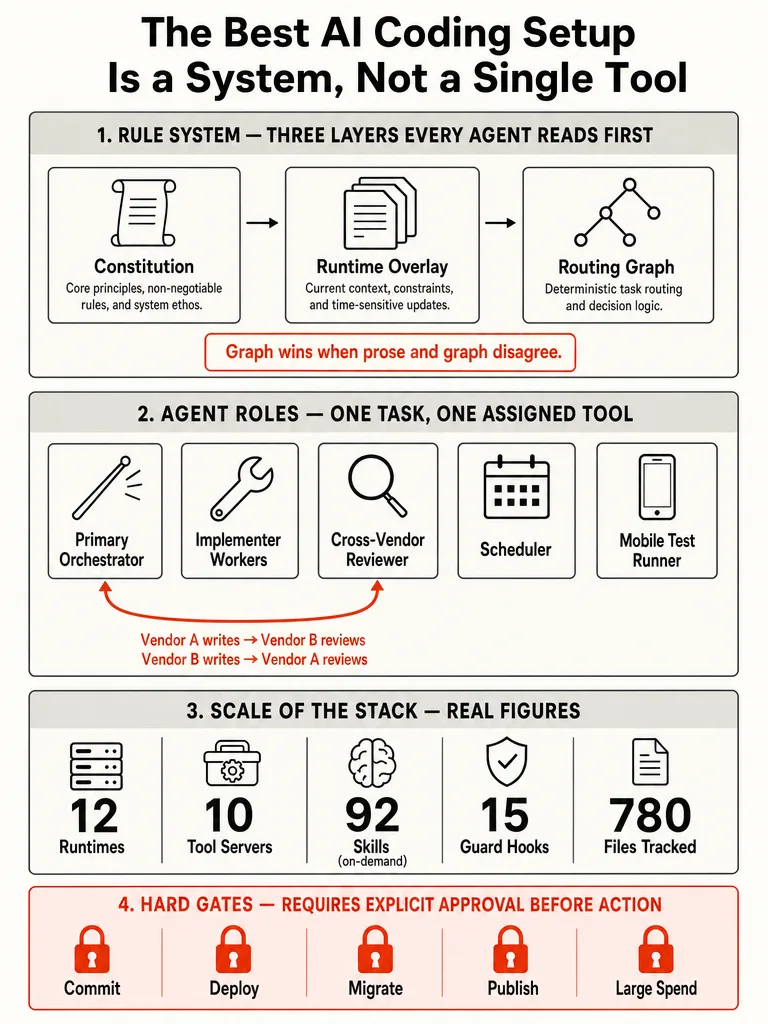
The best AI coding agent in 2026 isn't one tool. It's a rulebook-driven multi-agent system where different models plan, build, and review each other's work. Isaac Horowitz's live setup runs Claude Code, Codex, Cursor, Grok, OpenCode, Hermes, and Argent on a single Mac, and the published configuration accounts for 12 runtimes, 10 tool servers, 92 skills, 15 guard hooks, and 780 tracked files pulled straight from the repository.
Ranking lists want a single winner. The people actually shipping code stopped asking that question. MightyBot's 2026 ranking puts it plainly: the best teams have stopped picking one model and started assigning models per task, using an expensive model to plan and cheaper ones to execute in parallel.
That's the whole idea here. A Claude model or Codex orchestrates. Fast workers handle the mechanical edits. A second vendor reviews the first vendor's output. Risky actions stay locked behind explicit approval.
The best AI coding setup for 2026 is a system with named roles, cross-vendor review, and hard gates, not a subscription to whichever tool topped a list this month.
The rest of this article breaks down that system: who orchestrates, who reviews, what's gated, what it costs, and how to pick a setup that fits how you actually build. Want it built for you instead? Let's build something real.
Is there one best AI coding agent for everyone, or does the workflow decide?
There is no single best AI coding agent for everyone. The right choice depends on how much work the agent can do alone, how often it stays on track, and how much it costs as usage grows. The daily.dev comparison is blunt about it: pick the agent that fits your workflow and your team's review capacity, not the one with the biggest autonomy claim.
Autonomy claims are cheap. Verification is expensive. That same comparison cites a 2026 finding that 75% of AI coding agents broke working code during CI workflows. If an agent can quietly ship a regression, more autonomy just means more damage before anyone catches it.
So the real buying constraint isn't which model scores highest on a benchmark. It's how fast you can verify what the agent produced. An agent that ships twice as much work and doubles your review load hasn't saved you anything.
That flips the question. Instead of "which agent wins," ask "which setup lets me trust the output without reading every diff by hand." The answer to that is almost always a system with real tests, gated actions, and a second set of eyes, not one tool doing everything.
What is an AI coding agent when it has to ship real code?
An AI coding agent is a loop: it plans a task, reads your files, edits them, runs commands or tests, checks the result, and iterates until a check passes or it runs out of budget. Unlike autocomplete, it acts directly in your project instead of handing you a suggestion to paste. Vellum's 2026 review calls this shift from passive suggestion to active execution the thing that separates agents from the tools that came before.
The demo-to-production gap is where most of them fall apart. Vellum, citing the 2025 Stack Overflow Developer Survey, reports 84% of developers now use or plan to use AI tools, up from 76% the year before. But 66% say their biggest frustration is output that's close but not quite right, and 45% say debugging AI-generated code takes longer than expected.
That's the tell. An agent that impresses in a demo and creates cleanup work in production isn't shipping real code. It's generating review debt.
A production-grade agent has three things a demo doesn't: reliable tests as ground truth, a sandbox so it can't touch what it shouldn't, and explicit permissions on anything risky. Without those, the loop runs, but you can't trust where it lands.
How to set up AI coding agents without letting the stack drift?
You keep a multi-agent setup from drifting by giving every agent the same rulebook and making one file the tiebreaker. In Isaac's configuration, each agent reads three layers before it does anything: a constitution of rules that never change per task, a runtime overlay that sets which model orchestrates and which reviews, and a machine-readable routing graph. When the prose and the graph disagree, the graph wins.
Those layers live in real files, not a vibe:
- AGENTS.md is the constitution, 417 lines covering gates, binding delegate names, secrets, and cleanup. Every agent imports, symlinks, or reads it.
- ~/.agents/AGENTS.md is the runtime overlay at 185 lines: orchestrator choice, fast-worker order, cross-runtime review.
- agent-graph.yaml is the executable routing graph, the source of truth when anything conflicts.
- ENGINEERING-PRINCIPLES.md at 130 lines carries the doctrine for any change bigger than a small diff.
- mcp-registry.yaml catalogs every tool server and its pinned version.
- skills-policy.md at 59 lines sets progressive disclosure, so a skill body loads only when a task matches.
The terminalblog setup guide calls AGENTS.md the single biggest quality multiplier in a coding-agent setup, and that tracks with how this stack works.
Drift is handled mechanically. All agents share the same tool servers, the same 92-skill library, and the same shell guard. A small lint runs at the start of each session and prints a line the moment any of it has drifted. The whole arrangement is generated from the same files the agents read, so the documentation can't quietly fall out of sync with reality.
Which agent for which job in the actual 2026 setup?
Task routing is the core of the setup: each runtime has a defined job, and work flows to whoever fits the task. A Claude model (Fable 5.1 or Opus 5) or Codex orchestrates, splitting work and verifying results. Routine implementation goes to fast workers. Naming a delegate is binding, so "use Grok" means Grok, not whatever subagent was easiest to reach.
Here's how the jobs map in Isaac's live configuration:
| Runtime | Vendor | Job in the setup |
|---|---|---|
| Claude Code | Anthropic | Primary orchestrator: plans, splits work, verifies, reports |
| Codex | OpenAI | Orchestrator, implementer, and independent reviewer of Claude-written work |
| Cursor | Cursor | Bounded isolated-clone implementer and fresh-eyes reviewer |
| Grok | xAI | External delegate the moment Isaac names it |
| OpenCode | open source | Runs local and OpenRouter models against the same tools and rules |
| Hermes | Hermes | Scheduler and assistant; launches the CLIs, never edits product code |
| Argent | Software Mansion | iOS and Android app testing only |
The model roles get specific. Inside Claude Code, Sonnet 5 is the native fast worker and Haiku runs the four dispatcher agents that shell out to external delegates. Inside Codex, GPT-5.6 Luna handles clear bounded work, Sol takes ambiguous or architectural calls, and Terra runs read-heavy exploration and cross-vendor review. OpenCode defaults to a local Qwen model, with DeepSeek, Kimi, and GLM available through OpenRouter.
Argent's boundary is worth naming. It handles simulators, emulators, devices, screenshots, and UI automation for phones and tablets, and it never touches desktop web, Electron, or TV.
The setup doesn't ask which agent is best. It asks which agent is right for this specific task, and routes accordingly.
Claude Code vs Codex: which should orchestrate the coding workflow?
Both Claude Code and Codex can orchestrate in this setup; the choice depends on whether the job needs terminal-first depth across a large repo or fast implementation with structured model roles. Claude Code runs Fable 5.1 or Opus 5 as orchestrator, planning and splitting work across subagents. Codex runs the GPT-5.6 family day to day, Sol for judgment, Terra for exploration and review, and Luna for fast bounded work, with GPT-6 Astra reserved for one specific job explained below.
The strengths split cleanly. The daily.dev comparison notes Claude Code's 1M-token context window lets it work across large repos without a prebuilt index, and cites a May 2026 example where Dynamic Workflows ported 750,000 lines from Zig to Rust in 11 days with a 99.8% test pass rate. Codex leans the other way on speed: about 240 tokens per second, roughly 2.5x faster than Claude Opus, and the same comparison credits Codex with holding the published Terminal-Bench record.
| Orchestrator path | Best at | Key detail |
|---|---|---|
| Claude Code | Deep terminal work, large-context refactors | 1M-token context, subagents per model |
| Codex | Fast implementation, structured review | GPT-5.6 Sol/Terra/Luna roles, Astra unattended |
One hard limit sits on top of the roster. GPT-6 Astra is the only model in the setup allowed to work unattended, and only when Isaac explicitly asks for autonomous work. It runs by itself with no subagents or delegates unless Isaac names one. Every other agent, on both stacks, stays on a checkpoint.
Why cross-vendor review beats one-stack review
Cross-vendor review means the model that writes the code is never the model that approves it. In Isaac's setup, work written by Claude gets reviewed by Codex, and work written by Codex gets reviewed by Claude. The reason is simple: a reviewer from the same model family shares the author's blind spots, so it waves through the same mistakes it would have made itself.
This is the design choice most ranking lists skip entirely, and it's the one that pays. MightyBot's 2026 refresh puts it directly: mixing providers beats any single vendor's stack, and cross-provider review is the part that pays, because a model reviewing its own family's output repeats its own blind spots.
Line that up against the failure data. The daily.dev comparison's finding that 75% of AI coding agents broke working code during CI workflows is exactly the class of error a same-family reviewer misses and an outside reviewer catches.
The mechanics are enforced, not suggested. Codex pins GPT-5.6 Terra as the independent reviewer of Claude-implemented work. Claude pins Opus 5 as its blind verifier and code reviewer, never Fable. A delegated review can't quietly get re-routed to a subagent from the author's own family.
What gets gated before an AI coding agent can touch production?
Nine actions are gated in this setup and never happen without explicit authorization: committing, pushing, opening a pull request, deploying, publishing, running a database migration, posting to social media, writing to the marketing database, and spending money on a large media generation. Plain release language like "ship it" or "commit and push" counts as one authorization for the full chain. Nothing weaker counts, and nothing carries over from an earlier message.
That authorization rule is stricter than it looks. Delegates never commit, push, deploy, migrate, or publish, period. Decomposition, integration, and final verification stay with the parent orchestrator.
The enforcement layer sits underneath the rules:
- Shared shell guard: every agent runs the same
git-guard.shon shell commands, wired natively or through hook compatibility across all runtimes. - 15 guard hooks: documented across runtime bindings, so the guard behaves the same whether the command comes from Claude Code, Codex, Cursor, Grok, OpenCode, or Hermes.
- Sandboxing: a baseline requirement because agents read attacker-reachable inputs. As the jainmehul agents guide explains, an agent that reads issues, PR comments, code, and lockfiles is reading untrusted text.
- Secret scanners: every refresh runs two of them and refuses to sync if either finds a password, token, cookie, or account.
Nothing in the published 780-file snapshot contains a credential. The daily job refreshes the snapshot automatically, but committing and pushing it stays a human decision.
Most SERP content on "best AI coding agent" barely mentions any of this. That's the gap. A setup you can trust on a real repo is defined by what it refuses to do without asking, not by what it can do on its own.
How much does an AI coding agent setup cost when usage grows?
Cost in a serious setup is driven by token volume, not sticker price, and the right way to judge it is cost per reviewed change. The daily.dev comparison lists Claude plans at $20/mo, $100/mo, and $200/mo, with Opus API pricing at $5 per million input tokens and $25 per million output tokens. For heavy use, it estimates the top Max plans run roughly 18x cheaper than equivalent API usage.
The volume gap between tools is where budgets break. That same comparison notes Claude Code often burns 3-4x more tokens than tools like Codex, and Codex runs faster at about 240 tokens per second. Grok, per MightyBot, is priced at $2/$6 per 1M tokens, cheaper than Opus 5 at $5/$25.
None of that tells you your real cost. What matters is dollars per change that survives review. A mixed stack that plans on an expensive model and executes on cheaper ones keeps the token bill on the work that actually needs the frontier model.
How to choose an AI coding agent setup for MVPs and internal tools
Choose your setup by output you can trust, not by the tool that topped a ranking. Score any candidate on five things: shipped output, review capacity, gated risk, workflow fit, and production readiness. That framing beats every "top 5" list because, as multiple sources agree, there's no single best agent for everyone, only the setup that fits how you build.
Run this checklist before committing:
- Shipped output: does it produce working, reviewed changes, or just diffs you have to clean up?
- Review capacity: can a second model or a human verify the output faster than it's generated?
- Gated risk: are commits, deploys, migrations, and spend locked behind explicit approval?
- Workflow fit: does orchestration, delegation, and review match how your team actually works?
- Production readiness: real tests and sandboxing, or a demo that impresses and then breaks?
If you're a founder without an engineering team, the honest answer is that running a stack like this yourself is a full job. That's the case for having someone build and operate it for you. ZipLyne uses exactly this kind of system to ship AI-native MVPs and production AI apps, build custom internal tools, and decide honestly when an agency beats a freelancer on real timelines.
The setup is the edge. Getting it built without hiring a team is the point.
Frequently asked questions
Is there one best AI coding agent for everyone in 2026?
No single agent wins for every team. In a 2026 finding, 75% of AI coding agents broke working code during CI workflows — so the real question isn't which tool tops a list, it's which setup lets you verify output faster than it's generated. The best teams assign models by task: an expensive frontier model to plan, cheaper ones to execute in parallel, and a cross-vendor reviewer to catch what same-family models miss.
What is an AI coding agent and how is it different from autocomplete?
An AI coding agent plans a task, reads your files, edits them, runs commands or tests, checks the result, and loops until a check passes or it runs out of budget — acting directly in your project instead of handing you a suggestion to paste. The 2025 Stack Overflow Developer Survey found 84% of developers now use or plan to use AI tools, up from 76% the year before. The shift from passive suggestion to active execution is what separates agents from everything that came before.
Claude Code vs Codex: which should orchestrate my coding workflow?
Claude Code is the stronger orchestrator for large-repo terminal work — its 1M-token context window let Dynamic Workflows port 750,000 lines from Zig to Rust in 11 days with a 99.8% test pass rate. Codex runs about 240 tokens per second (roughly 2.5x faster than Claude Opus) and holds the published Terminal-Bench record, making it the better pick for fast parallel execution. In a mixed setup, Claude Code orchestrates while Codex handles implementation and cross-vendor review.
Why does cross-vendor review produce better results than single-stack review?
A model reviewing its own family's output repeats its own blind spots — it waves through the same mistakes it would have made. MightyBot's 2026 analysis is direct: mixing providers beats any single vendor's stack, and cross-provider review is the part that pays. In a properly wired setup, Claude-written code gets reviewed by Codex (GPT-5.6 Terra), and Codex-written code gets reviewed by Claude (Opus 5) — no re-routing to a subagent from the author's own family.
What actions should always be gated before an AI coding agent can run them?
Nine actions should never happen without explicit authorization: committing, pushing, opening a pull request, deploying, publishing, running a database migration, posting to social media, writing to a marketing database, and spending money on large media generation. Plain release language like 'ship it' counts as one authorization for the full chain — nothing weaker qualifies, and nothing carries over from an earlier message. Delegates never handle any of these; the parent orchestrator owns decomposition, integration, and final verification.
How much does a serious AI coding agent setup cost as token usage grows?
Cost is driven by token volume, not sticker price. Claude plans run $20, $100, or $200/month, with Opus API at $5 per million input tokens and $25 per million output. Claude Code often burns 3–4x more tokens than tools like Codex, which runs faster at ~240 tokens per second. Grok is priced at $2/$6 per 1M tokens versus Opus 5 at $5/$25. The right metric is dollars per change that survives review — a mixed stack that plans on a frontier model and executes on cheaper ones keeps that number manageable.
Sources
- I Tried 20+ AI Coding Tools: Here Are My Top 5 ...www.vellum.ai
- Best AI Coding Agents in 2026, Rankedwww.red-gate.com
- The best AI developer tools in 2026: from coding agents to ...www.jainmehul.com